
AI vs. Carbon: How Machine Learning Fights Ad Emissions

Published on
Summary
How much did you spend on your last ad campaign?
The real cost goes beyond CPLs and CPAs. It’s everything you spent, plus the carbon emissions of advertising generated from each process in the pipeline.
Every impression, click, and view adds up, powered by energy-intensive data centers and bidding infrastructure.
As sustainability climbs up the public agenda, CMOs operating in 2025 must ask themselves: Could AI be the solution to lower ad emissions and better performance?
This blog explores how AI/ML helps brands move toward net-zero advertising strategies.
Introduction
Behind all digital ads are carbon emissions that you don’t see.
But reducing emissions in advertising isn’t just about reducing media buys, shifting to traditional mediums, or altering creative output.
Marketers need to rethink their approach to campaigns using tools to prevent emissions before they are created, and offset unavoidable ones post-facto.
The Carbon Impact of Advertising
Digital advertising builds modern brands, but it also builds carbon emissions.
Programmatic display and video ads are now core components of most media plans. But the system involved in creating them contributes to ad emissions.
Every auction and data transfer triggered by ad impressions consumes energy. According to recent data, 60% of carbon from programmatic advertising originates from the supply chain.
Decarbonizing ads means switching to sustainable processes that reduce carbon emissions at every step
How Can AI Reduce Carbon Emissions?
Even in AI’s current state, it's already making meaningful contributions to ad sustainability.
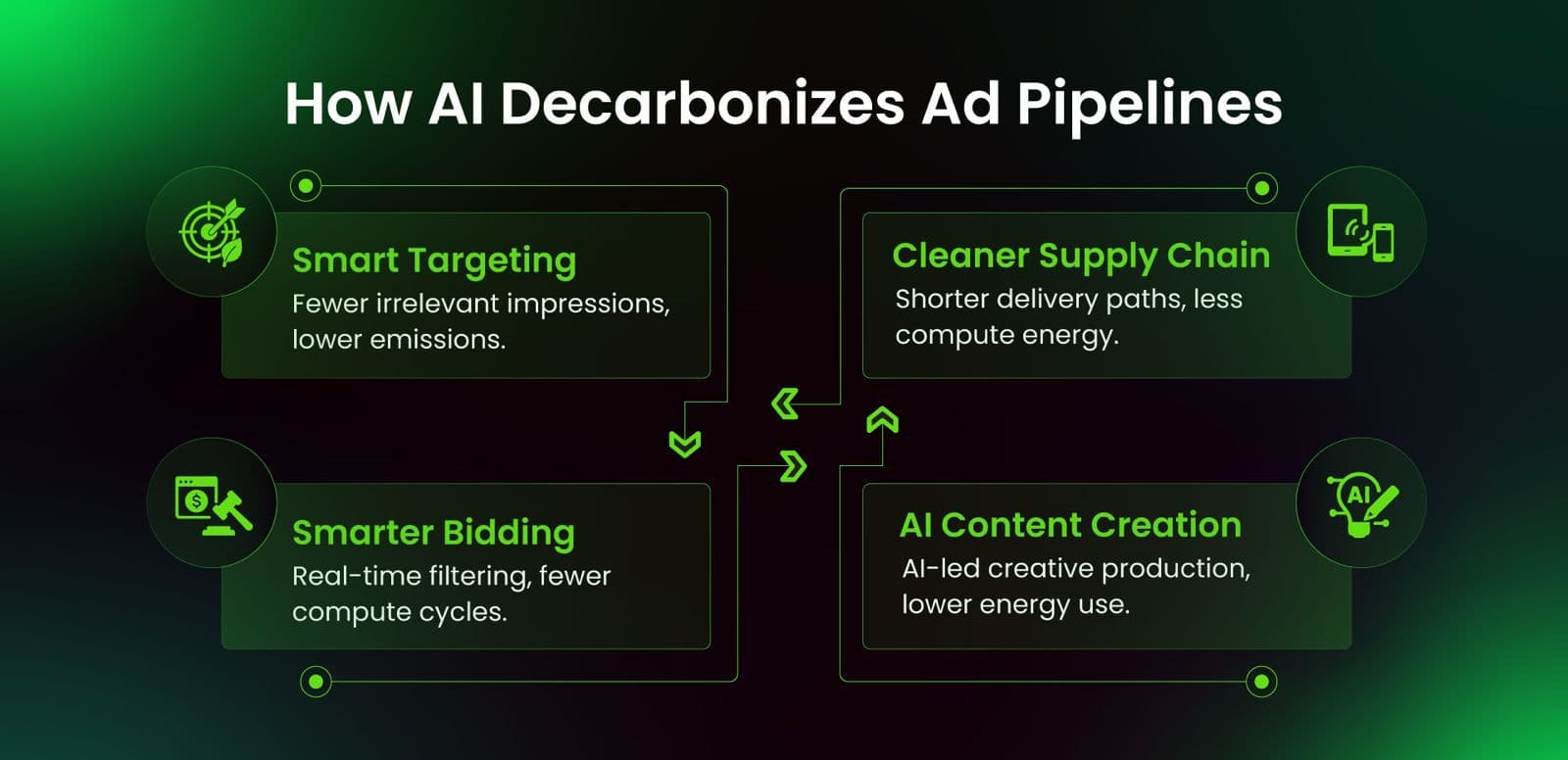
Here are 4 ways AI is already supporting greener advertising:
-
1. Smarter Ad Targeting, Fewer Emissions
Most digital campaigns still rely on blanket targeting or outdated audience models, leading to irrelevant impressions that consume bandwidth, spike server calls, and increase emissions.
AI uses predictive models to ensure ads are only shown to users who are most likely to engage. This reduces redundant impressions, increases ROAS, and cuts energy usage across the delivery chain. -
2. Cleaner Ad Supply Chain
AI can reduce the complexities of traditional programmatic value chains, by optimizing the entire ad pipeline and reducing the overall energy load involved in campaign execution. -
3. Smarter Bidding, Less Compute Waste
RTB systems run millions of auctions per second, many of which are for impressions that don’t meet campaign goals. Machine learning can pre-filter inventory and suppress low-value bids, avoiding unnecessary compute cycles and emissions. -
4. AI-Driven Content Creation
Brands use AI to produce thousands of digital content pieces at blazing fast speeds, supporting personalized advertising at scale. This approach not only simplifies content creation but also reduces the carbon footprint by minimizing the need for extensive human-led production efforts.
Together, these innovations point toward a future where emissions aren’t a trade-off for ad performance; they’re a solvable problem. As machine learning models continue to evolve, their ability to predict, optimize, and decarbonize advertising workflows will only get stronger.
Is AI a Feasible Net-Zero Solution?
While carbon emissions from machine learning consume energy, its intelligent application in advertising can more than offset that impact. The goal isn't only to neutralize waste post-facto, but to design systems that avoid it from the get-go.
That’s the idea behind Climaty AI’s Measure - Optimize - Offset model:
-
1. Measure
Carbon measurement starts with full visibility. Climaty AI connects directly to your digital platforms through high-speed API integrations and offers flexible inputs for offline media. Every campaign is assessed end to end, from channel mix to delivery type. -
2. Optimize
Once measured, Climaty AI helps you through two distinct systems: Programmatic+ and Agentic AI.
Programmatic+ optimizes your supply path with direct publisher integrations - cleaner, faster, built for control and transparency.
Together, these agents operate across channels under your control, keeping brand safety in mind while adjusting every decision based on live performance data. Climaty’s agentic AI ecosystem helps you reduce emissions by up to 30% while strictly adhering to brand safety guidelines.
-
3. Offset
Climaty AI connects to verified offset programs where every credit is traceable, certified, and aligned with leading climate standards, fulfilling your ad net zero targets.
When used right, AI-first campaign tools like Climaty AI unify the fragmented marketing pipeline, simplifying the process for marketers.
Achieve Performance and Sustainability Goals with AI-Powered Marketing.
Case Study: Sustainable AI in Marketing
FlyX Marketing: AI-first Green Advertising
Headed by Albert Valiakhmetov, FlyX Marketing launched its AI-powered Green Strategy in February 2025.
Core Strategy:
- Eco-Optimized Websites: Reduced data-heavy elements to improve load times and cut carbon output by 72% per page view
- Smarter Resource Management: Used AI to time email and content delivery more efficiently, achieving a 70% drop in CO₂ emissions per email.
- Sustainable Ad Practices: Lowered emissions per 1,000 impressions by 61% through cleaner formats, improved targeting, and leaner retargeting.
FlyX Marketing's AI-powered Green Strategy is an exceptional example of how AI and machine learning can combat carbon emissions generated by digital marketing practices.
Conclusion
Digital advertising is at a crossroads: one path continues to prioritize volume and reach at environmental cost; the other leans on machine learning to build smarter, cleaner pipelines.
If implemented thoughtfully, AI won’t just clean up media plans, but transform how we measure success in the first place.
The long-term potential is clear to see. AI can help the ad industry decarbonize without sacrificing results. Platforms like Climaty AI are embracing this transition, combining sustainability metrics with media performance to drive tangible impact.
With AI-driven decisions, it’s possible to lower emissions while improving performance. Not by compromise, but by better design.



