
Can AI Innovation and Sustainability Coexist?
Published on
Summary
AI models like ChatGPT, Grok3, and DeepSeek are advancing fast, powering tools across industries. But behind this growth is a sharp rise in carbon emissions and water use. Data centers that train and run these models consume enormous energy, with their impact expected to grow by 2030. While some companies are building more energy-aware systems, the push for bigger, smarter models outpaces sustainability efforts. The gap between AI’s progress and its environmental footprint is widening. If AI is to remain a force for good, sustainability must move from an afterthought to a priority. Can intelligence and impact coexist? This blog breaks it down.
AI chatbots have come a long way. Grok3, DeepSeek, and ChatGPT are pushing the boundaries of automation, reshaping industries, and making interactions smarter.
From answering complex queries to generating human-like conversations, the capabilities of these models are nothing short of groundbreaking.
But innovation comes with a price.
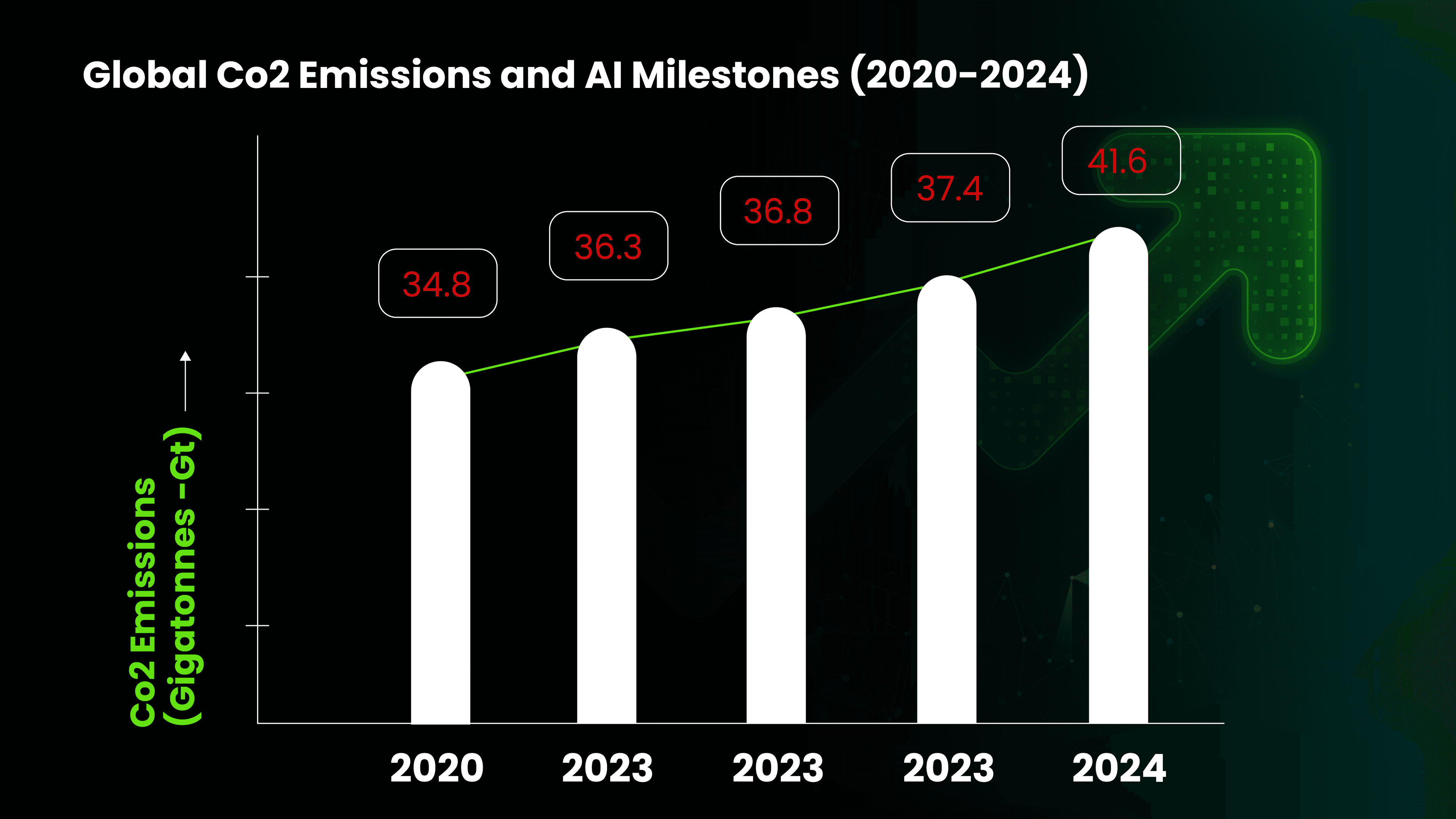
The energy consumption of AI is skyrocketing, and with it, the environmental cost. Training just one large AI model can emit as much carbon as five cars over their entire lifetime.
And that’s before considering the water usage for cooling massive data centers or the e-waste generated from the hardware that powers it all.
None of this means AI is the villain here. The progress it brings is undeniable. But as AI evolves, so should the conversation around its sustainability.
AI’s Energy Hunger: The Cost of Intelligence
AI chatbots don’t just exist in the cloud - they run on vast networks of energy-intensive data centers.
Some reports suggest tech giants' data center emissions may be up to 7.6 times higher than reported.
And it’s not just electricity - water plays a hidden role too. AI data centers require enormous amounts of water to prevent overheating.
Meanwhile, global advertising spend is surging, set to surpass $1 trillion this year, with digital advertising leading the charge. Social media ad spend alone is forecasted to hit $233.65 billion by 2027, up from $130.24 billion in 2022
The question isn’t whether AI should advance - it absolutely should.
But can we make it smarter about its footprint? Can innovation evolve without an unchecked environmental toll?
These are the things the industry needs to start prioritizing, just as much as it prioritizes performance.
Smarter Tech Shouldn’t Cost the Earth
Measure, optimize and offset your campaign's Co2 emissions today.
Smarter AI, Smaller Footprint
The question isn’t just how fast AI can get - it’s whether that speed is coming at an irreversible cost.
The reality is that companies building models know the energy demands, and some are making moves to reduce them.
For instance, DeepSeek has positioned itself as a more energy-efficient model, optimizing computational power to lower emissions.
OpenAI, the creators of ChatGPT, have been exploring ways to run AI models on cleaner energy sources.
Meanwhile, some data centers are shifting toward liquid cooling systems that use less water while improving energy efficiency.
But these efforts are still in their early stages. The demand for bigger, more powerful AI is outpacing the industry's ability to prioritize sustainability.
The challenge is finding a way to balance performance with responsibility, because ignoring the problem won’t make it disappear.
Some industries are already addressing this. Take digital advertising, where energy use is growing just as fast as AI adoption.
Companies are now looking at ways to track, optimize, and reduce emissions without compromising efficiency. That’s exactly the kind of approach Climaty AI takes.
The future of AI is exciting. It’s not about slowing down innovation, it’s about ensuring that progress isn’t measured only in performance gains, but also in efficiency and sustainability.
Do’s & Don’ts
The AI industry is at a turning point. Growth is inevitable, but so is the need for smarter, more sustainable practices. Here’s how the industry can move forward without letting carbon emissions, energy waste, and digital inefficiencies spiral out of control.
Do’s: Steps Toward a More Sustainable AI
-
Prioritize Energy Efficiency in AI Training & Deployment
Companies need to focus on optimizing model training to reduce computational waste. Techniques like knowledge distillation, pruning, and quantization can help minimize power consumption without sacrificing performance.
-
Invest in Clean Energy for Data Centers
Tech firms should use solar, wind, or hydropower to commit to 100% renewable energy-powered data centers. AI shouldn't be dependent on fossil fuels to function.
-
Make Carbon Measurement a Standard Practice
If companies don’t measure their carbon footprint, they can’t reduce it. AI developers should track and disclose energy consumption, emissions, and water use, making sustainability a key performance metric.
-
Optimize AI Workloads
Companies should adjust AI processing based on demand instead of running models at full capacity 24/7. Dynamic scaling and adaptive computing can significantly reduce unnecessary energy use.
-
Extend Hardware Lifespan & Reduce E-Waste
AI relies on powerful GPUs and TPUs, but rapid hardware turnover creates massive electronic waste. Using modular, upgradeable components and investing in circular economy practices can help mitigate this issue.
Don’ts: What the Industry Should Avoid
-
Building AI Without an Efficiency Plan
Launching larger, more power-hungry models without optimizing energy use amplifies the problem. AI development should include sustainability strategies from day one.
-
Overlooking Water Consumption in Data Centers
Cooling AI infrastructure is draining water resources, especially in regions facing shortages. Companies must adopt liquid immersion cooling or air-cooling alternatives to reduce dependency on freshwater.
-
Ignoring Carbon Offsetting & Mitigation
Some emissions are unavoidable, but that doesn’t mean they should be ignored. Companies should integrate verified carbon offset projects into their AI operations.
-
Chasing Scale Without Considering Impact
Bigger isn’t always better. AI firms must balance power with responsibility, ensuring every advancement considers resource efficiency, energy use, and environmental consequences.
AI is powerful, but it also has the potential to optimize itself for sustainability. Platforms like Climaty AI are already applying AI-driven efficiency models to industries like digital advertising, showing that smart technology can cut emissions, reduce waste, and improve resource use without sacrificing performance.
If AI can predict human behavior, generate complex code, and run entire industries, it should also be able to optimize its own energy consumption. The technology is here - the responsibility is now on the industry to use it wisely.
Conclusion
AI isn’t slowing down - Grok3, DeepSeek, and ChatGPT are just the beginning of a future where machines become deeply embedded in how we work, communicate, and innovate.
But as AI scales, so does its energy consumption, carbon footprint, and resource demand. The conversation can’t just be about making AI bigger and more powerful; it has to be about making it more efficient and responsible.
Industries that rely on AI are already recognizing this challenge. The focus is shifting toward optimizing energy use, minimizing emissions, and reducing unnecessary digital waste.
But these changes need to happen at scale, across industries, and at a faster pace. AI can’t afford to be reactive - it must be built with sustainability in mind.
The focus now should be on making AI work smarter, not just for businesses, but for the planet too.



