
The Invisible Work of Agentic AI: Micro-decisions that Transform Media Performance
Published on
Executive Summary
Digital advertising performance is commonly attributed to visible strategic decisions: channel allocation, budget sizing, audience selection, or creative direction. While these decisions remain important, they now represent only the outermost layer of performance control. Beneath them lies a far more influential layer: the continuous stream of micro-decisions executed inside live media systems.
Modern advertising platforms operate within real-time, auction-driven environments, where each impression opportunity is evaluated and resolved within approximately 100–150 milliseconds, as documented in Google’s real-time bidding architecture. Within this time window, platforms evaluate bids, predict engagement, assess relevance, and determine delivery. Performance outcomes are therefore shaped less by periodic human intervention and more by the aggregate quality of thousands of automated decisions made every minute.
Agentic AI introduces a fundamentally different optimization paradigm. Rather than relying on predefined rules or static automation, agentic systems operate as goal-directed, adaptive entities. They continuously perceive signals from the media environment, reason about optimal actions, execute decisions autonomously, and update their behavior through feedback loops grounded in reinforcement learning and probabilistic modeling.
This whitepaper examines how micro-decisions function as the true drivers of media performance, why humans are structurally limited in managing them, and how agentic AI systems unlock compound performance advantages across channels such as Search, Social, Programmatic Display, Video, and Retail Media.
Why Media Performance Is the Sum of 10,000 Micro-Actions
Historically, media optimization was approached as a planning problem. Campaigns were designed upfront, launched, and then adjusted periodically based on aggregated reports. This approach assumed relative stability in user behavior, auction dynamics, and competitive activity.
That assumption no longer holds.
Digital advertising environments today are:
- High-frequency: auctions occur millions of times per day
- High-dimensional: decisions depend on hundreds or thousands of contextual features
- Non-stationary: user intent, competition, and pricing shift continuously
From a systems perspective, this transforms media optimization into a continuous control problem, more closely resembling financial trading or supply-chain optimization than traditional marketing.
Academic literature frames such environments as sequential decision-making under uncertainty, commonly modeled using Markov Decision Processes and reinforcement learning frameworks.
In this context, performance is not determined by a handful of large decisions, but by:
- Thousands of incremental bid adjustments
- Constant reallocation of budget across segments
- Continuous prioritization of creatives, audiences, and placements
Each micro-action may appear insignificant in isolation. However, when executed repeatedly across millions of impressions, their cumulative impact becomes the dominant performance driver.
What Micro-Decisions Look Like in Practice
Each micro-action may appear insignificant in isolation. However, when executed repeatedly across millions of impressions, their cumulative impact becomes the dominant performance driver.
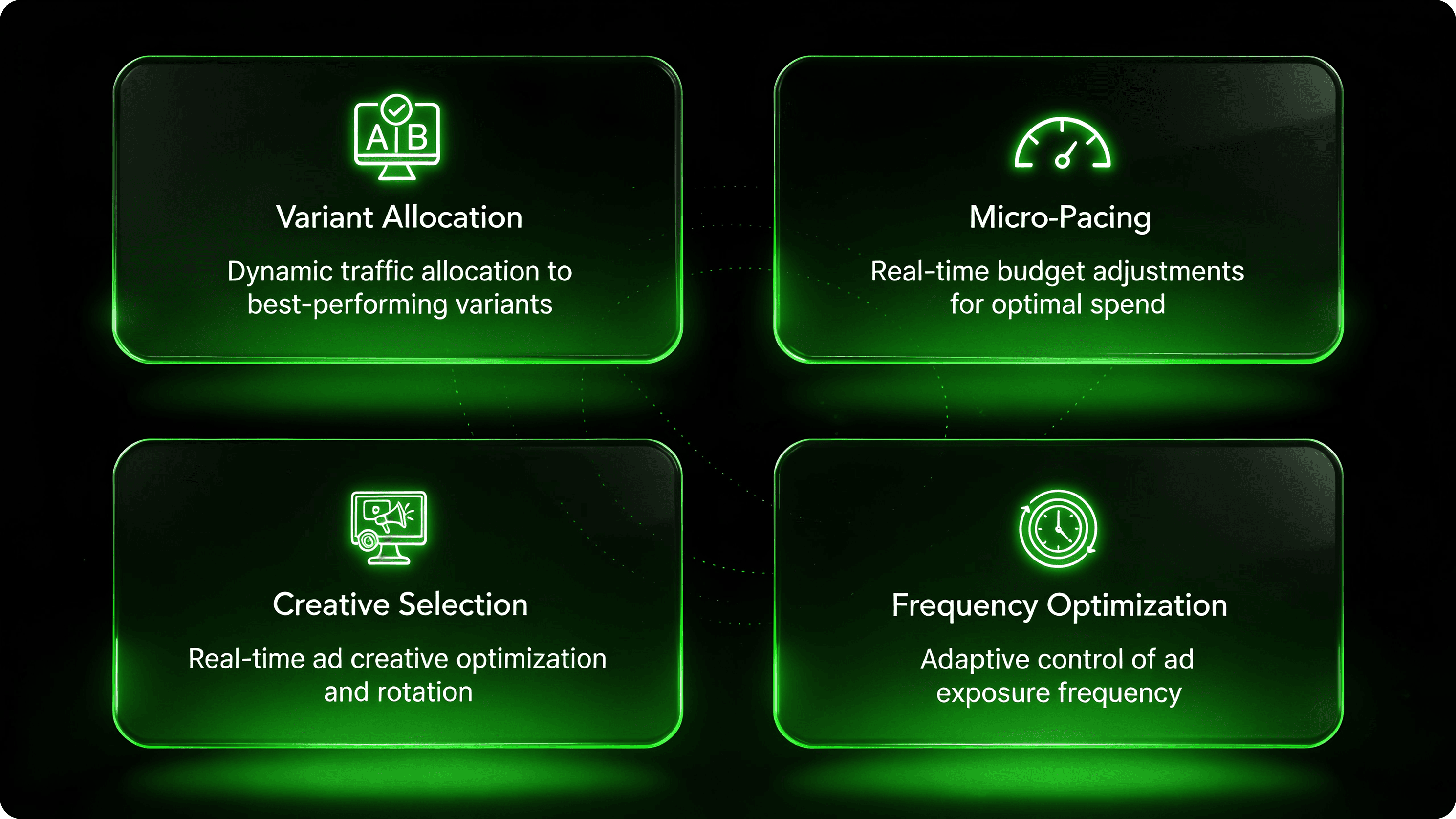
1. Continuous Variant Allocation via Contextual Bandits
Traditional A/B testing frameworks assume fixed test windows and delayed evaluation. In contrast, agentic systems use contextual multi-armed bandit models, which dynamically allocate traffic based on both historical reward and real-time contextual features such as device type, time of day, placement characteristics, and audience signals.
In this formulation, each creative or targeting variant is treated as an “arm,” and the system continuously updates its allocation policy to maximize expected reward. Traffic is never fully locked into a single “winner”; instead, it is continuously rebalanced as new information emerges. A detailed explanation of contextual bandits and their application to adaptive decisioning is provided by Microsoft Research.
Empirical studies applying contextual bandit models to programmatic advertising environments have demonstrated click-through rate improvements exceeding 20% and acquisition cost reductions approaching 20% compared to heuristic rotation strategies.
2. Micro-Pacing and Budget Flow Control
Budget pacing is often treated as a coarse control variable, adjusted daily or hourly to prevent overspend or underdelivery. Agentic systems instead treat pacing as a continuous decision variable, adjusting spend incrementally in response to real-time demand signals.
Even minor pacing adjustments typically in the range of ±1-5% can materially alter exposure during high-intent windows. Reinforcement learning research on budget-constrained bidding shows that adaptive pacing policies outperform static pacing rules by maintaining efficiency under volatile auction conditions.
The value of micro-pacing lies not in dramatic reallocations, but in constant correction, ensuring that capital flows toward moments of highest marginal return.
3. Creative Selection as a Real-Time Decision System
Dynamic Creative Optimization (DCO) reframes creative from a static asset into a decision variable. Rather than serving predefined ads, DCO systems dynamically assemble creatives by selecting combinations of headlines, images, formats, and calls-to-action based on predicted performance.
DCO systems evaluate creative performance at the impression level and adapt continuously using engagement feedback and contextual data. Industry analyses report engagement uplifts ranging from 15% to 40%, depending on creative diversity and data richness.
The rapid growth of the DCO market, projected to nearly double by 2032, reflects increasing reliance on automated creative decisioning as a core performance lever.
4. Frequency and Exposure Optimization
Frequency management is a nonlinear optimization problem. Excess exposure leads to diminishing returns and creative fatigue, while insufficient exposure limits recall and conversion probability.
Agentic systems model frequency-response curves at the user or segment level and adjust exposure dynamically. AI-driven frequency optimization has been shown to reduce wasted impressions while preserving conversion lift, particularly in retargeting scenarios.
How Agentic AI Identifies Opportunity Windows
Agentic AI systems ingest high-velocity data streams, including impression-level performance, auction prices, engagement latency, and downstream conversion signals. Advanced Bayesian and deep learning models enable inference at sub-10-millisecond latency, which is critical for real-time bidding environments.
At the core of these systems lies the exploration–exploitation trade-off. Contextual bandit and reinforcement learning models formalize this trade-off mathematically, enabling disciplined experimentation without destabilizing performance.
The Compound Effect of Small Decisions
A single 2–3% improvement in a metric such as CPA or conversion rate appears marginal in isolation. Sustained across millions of interactions, however, such improvements compound into material business impact.
Industry simulations and applied research consistently show that combined efficiency gains across bidding, creative selection, and targeting frequently exceed 20% aggregate lift over multi-month campaign horizons, driven not by singular optimizations but by thousands of continuous micro-corrections.
Human Limits vs. Agentic Advantage
Human optimization operates episodically and relies on aggregated signals. Agentic AI systems operate continuously, maintaining persistent memory across channels and time. Comparative studies consistently demonstrate that adaptive, learning-based bidding systems outperform manual and rule-based approaches, particularly under volatile auction conditions.
The implication is not human replacement, but role redefinition. Humans define objectives, constraints, and risk tolerances; agentic systems execute those intentions at machine speed.

Manual Optimization vs Rule-Based Automation vs Agentic AI Optimization
Manual Optimization Architecture
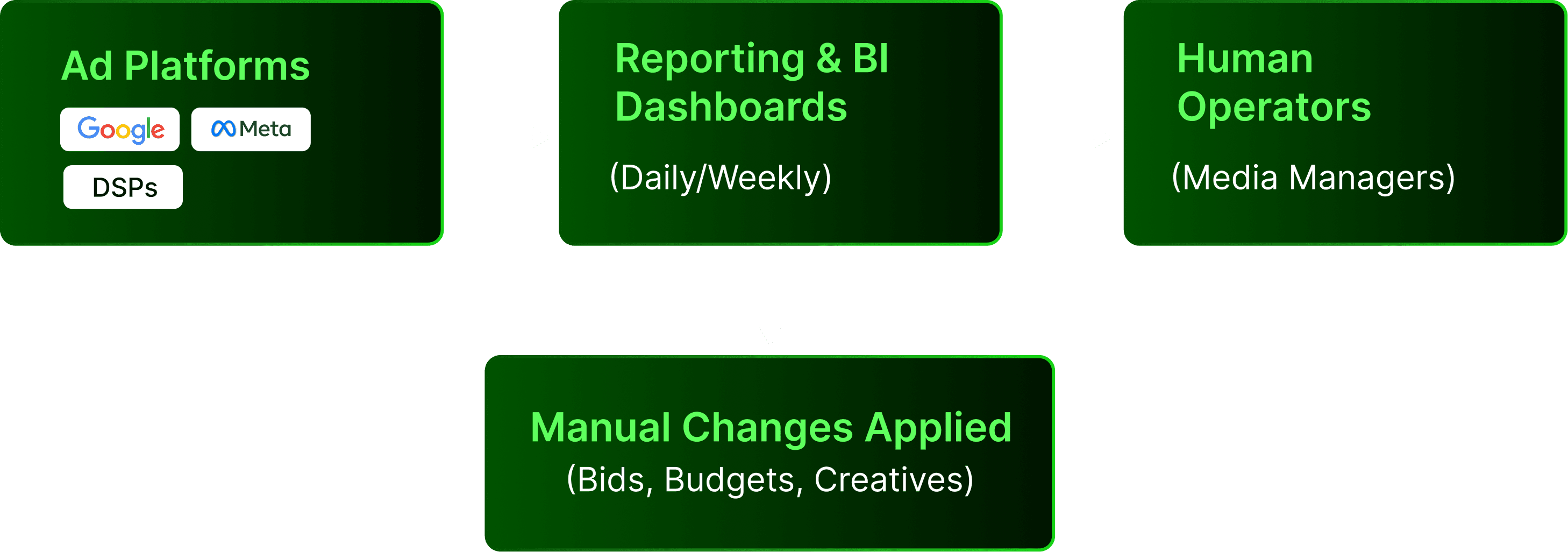
• Decisions occur outside the delivery loop
• Feedback is aggregated and delayed
• Humans act as the primary decision engine
• Optimization cadence is episodic (hours/days)
Rule-Based Automation Architecture
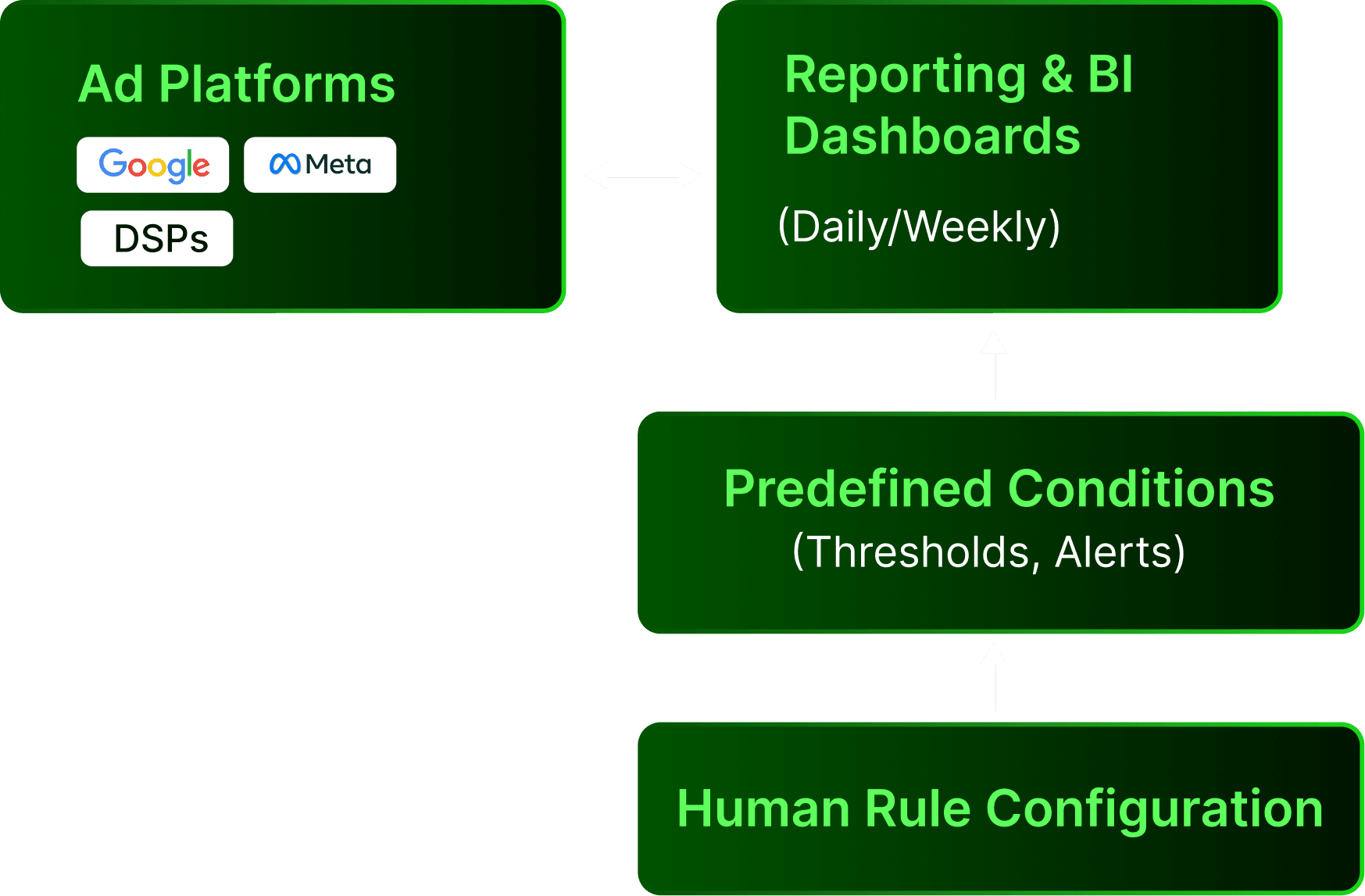
• Decisions move closer to execution
• Logic is static and pre-authored
• Limited context awareness
• Rules degrade as environments change
Agentic AI Optimization Architecture
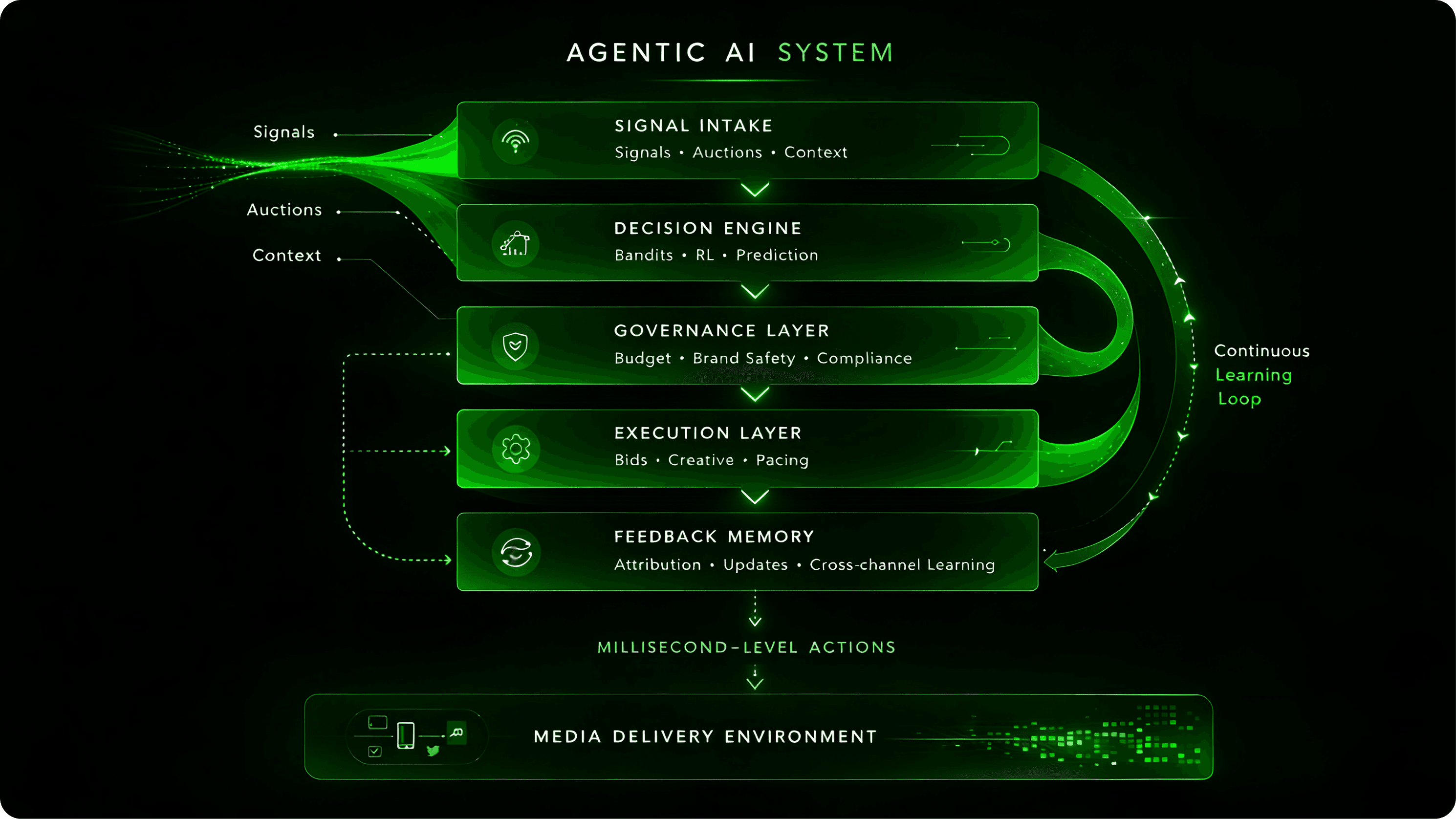
• Embedded, Real-Time Decisioning
• Continuous Learning Through Closed Feedback Loops
• Separation of Strategy and Execution
• System-Level Orchestration Across Multiple Optimization Dimensions
Comparative View: Manual Optimization vs Rule-Based Automation vs Agentic AI Optimization
| Dimension | Manual Optimization | Rule-Based Automation | Agentic AI Optimization |
|---|---|---|---|
| Decision Cadence | Periodic (daily, weekly, or ad-hoc reviews) | Event-triggered or scheduled (if-then logic) | Continuous, real-time (per impression / per auction) |
| Decision Volume | Tens to hundreds of decisions per campaign lifecycle | Hundreds to low thousands | Thousands to millions of micro-decisions per day |
| Latency to Action | Hours to days between signal detection and action | Minutes to hours depending on rule execution | Milliseconds (within auction and delivery windows) |
| Adaptability to Change | Low – dependent on human availability and interpretation | Moderate – limited to predefined conditions | High – adapts dynamically to non-stationary environments |
| Handling of Complexity | Poor – humans struggle with high-dimensional signal spaces | Limited – rules break under combinatorial complexity | Strong – designed for high-dimensional, stochastic systems |
| Learning Capability | None – relies on human memory and intuition | None or minimal – static logic unless manually updated | Continuous learning via feedback loops and reinforcement learning |
| Exploration vs Exploitation | Largely exploitative; exploration is slow and risky | Fixed exploration (if any) defined manually | Dynamically balanced through contextual bandits and RL |
| Creative Optimization | Manual swaps based on aggregated reports | Predefined rotation rules | Dynamic Creative Optimization with real-time performance feedback |
| Budget & Pacing Control | Coarse adjustments (daily/hourly) | Rule-triggered reallocation | Continuous micro-pacing based on real-time opportunity |
| Frequency Management | Static caps applied broadly | Rule-based caps with limited flexibility | Dynamic, user- or segment-level frequency tuning |
| Contextual Awareness | Fragmented across dashboards and tools | Narrow, rule-specific context | Holistic, persistent contextual memory across channels & time |
| Scalability Across Channels | Poor – linear increase in human effort | Moderate – rules multiply quickly and become brittle | High – single system scales across channels and geographies |
| Resilience to Market Volatility | Low – slow reaction to auction or demand shifts | Moderate – reacts only to known scenarios | High – detects and adapts to emerging patterns automatically |
| Governance & Control | Human-enforced, post-hoc | Hard-coded constraints | Constraints embedded directly into decision logic |
| Explainability & Auditability | High (human rationale) but inconsistent | Moderate (rule traceability) | High when designed with decision logs and model explainability |
| Primary Failure Mode | Missed opportunities due to slow response | Overfitting to outdated rules; brittle logic | Misaligned objectives if governance is poorly defined |
| Performance Outcome | Incremental, inconsistent improvements | Predictable but capped improvements | Compounding performance gains over time |
| Strategic Role of Humans | Tactical execution and monitoring | Rule design and exception handling | Objective-setting, governance, and strategic oversight |
Use Cases Across Media Channels
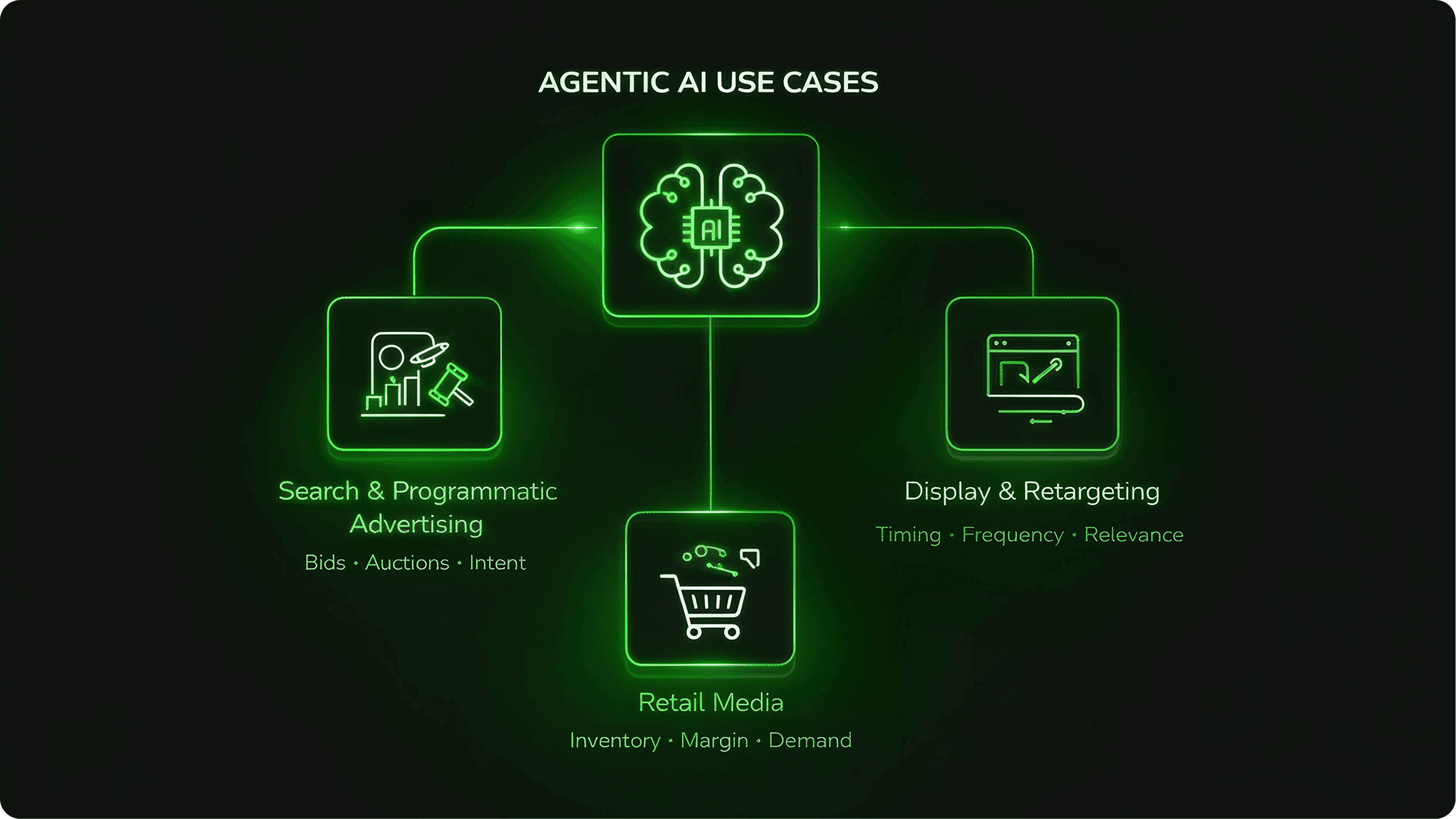
Agentic AI systems do not operate uniformly across channels. Each media environment presents distinct decision constraints, signal structures, latency requirements, and optimization objectives.
The value of agentic micro-decisioning lies in its ability to adapt its decision logic to the structural realities of each channel, while maintaining a unified optimization objective at the system level.
Search and Programmatic Advertising
Search and programmatic environments are fundamentally auction-driven and intent-sensitive, making them particularly well-suited to reinforcement learning–based optimization.
In sponsored search, each auction requires the system to determine:
• An appropriate bid price
• Eligibility for participation
• Expected value given query intent, competition, and historical outcomes
Reinforcement learning (RL) models treat this as a sequential decision-making problem, where each bid influences not only immediate outcomes (clicks or conversions) but also future learning and budget availability. Research on reinforcement learning for sponsored search demonstrates that RL-based bidding policies can outperform static or rule-based strategies by learning optimal bid adjustments under budget and ROI constraints, particularly in non-stationary auction environments.
In programmatic display and real-time bidding (RTB), the complexity increases further. Each impression opportunity arrives with a high-dimensional feature set - including user context, placement attributes, floor prices, and historical performance signals - and must be evaluated within strict latency limits (often under 100 milliseconds). Contextual bandit and reinforcement learning models enable systems to:
• Continuously adapt bid prices based on predicted conversion probability
• Allocate budget dynamically across segments and inventory sources
• Respond immediately to shifts in auction competitiveness
Empirical studies applying contextual multi-armed bandit models to RTB environments report significant improvements in click-through rates and cost efficiency, with reductions in acquisition cost of nearly 20% compared to heuristic bidding approaches.
Crucially, these gains do not come from singular bid changes, but from thousands of micro-adjustments executed continuously, each refining the system’s understanding of value at the impression level.
Display and Retargeting
Display and retargeting channels introduce a different optimization challenge: managing relevance and efficiency at scale across repeated exposures.
Unlike search, where intent is explicit, display environments rely heavily on inferred intent and behavioral signals. Agentic AI systems in this context focus on:
• Predicting likelihood of engagement or conversion based on behavioral history
• Determining optimal timing and frequency of exposure
• Selecting creative variants that maximize incremental lift rather than raw engagement
Contextual targeting models powered by deep learning enable far more granular personalization than traditional segment-based approaches. Instead of assigning users to static audiences, agentic systems evaluate each impression opportunity in real time, using contextual features such as browsing behavior, recency signals, device context, and historical responsiveness.
RTB House, a large-scale programmatic advertising company, has publicly documented how AI-driven contextual and behavioral modeling improved ad personalization accuracy by approximately 41–50%, resulting in more efficient retargeting and reduced impression waste. This improvement is attributable not to a single model, but to continuous micro-decisions that determine whether, when, and how an ad should be shown to a given user.
In retargeting scenarios, agentic systems also dynamically adjust frequency caps based on observed response curves. Rather than applying uniform exposure limits, they modulate frequency at the user or segment level to avoid fatigue while preserving conversion probability, an approach shown to reduce diminishing returns in high-frequency environments.
Retail Media
Retail media introduces an additional layer of complexity by tightly coupling advertising decisions with commerce-specific constraints such as inventory availability, pricing dynamics, and product margins.
In these environments, agentic AI systems must integrate:
• Real-time behavioral signals (search queries, product views, cart activity)
• Inventory and stock-level data
• Pricing and promotion states
• Conversion probability and downstream revenue impact
Rather than optimizing purely for engagement or clicks, agentic systems in retail media optimize for commercial outcomes, such as incremental revenue, margin efficiency, or sell-through velocity.
Micro-decisions include:
• Adjusting bids based on product availability or overstock risk
• Prioritizing products with higher conversion likelihood or strategic importance
• Dynamically reallocating spend as consumer demand shifts
The key distinction in retail media is that advertising decisions directly influence supply-side outcomes, making real-time adaptation critical. Agentic systems continuously rebalance exposure across products and categories, ensuring that spend is aligned with both consumer intent and business constraints.
Operationalizing Micro–Decision Systems
Deploying agentic AI for media optimization is not a matter of adding another automation layer. It requires a fundamental re-architecture of how decisions are made, executed, and governed.
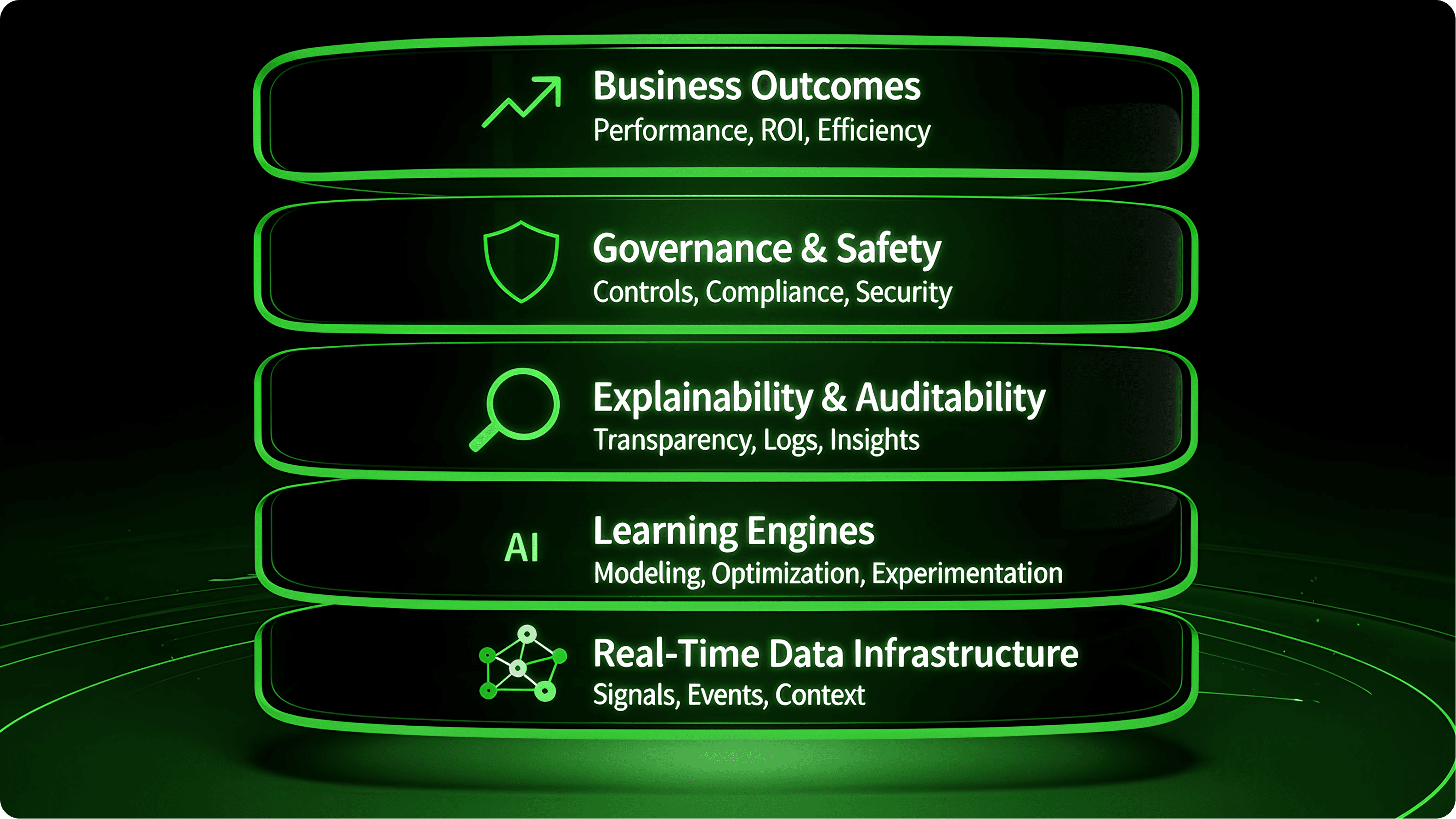
Real-Time Data Infrastructure
At the foundation lies a real-time data layer capable of ingesting:
• Impression-level performance data
• Auction metadata and pricing signals
• User interaction and conversion events
• First-party and third-party contextual inputs
This data must be processed with low latency and high reliability to support real-time decisioning. Delayed or aggregated data severely limits the effectiveness of micro-decision systems, as opportunity windows often exist only briefly.
Learning–Based Decision Engines
Above the data layer sit learning-based decision engines, typically built using:
• Contextual bandits for exploration–exploitation balance
• Reinforcement learning models for sequential optimization
• Predictive models for outcome estimation
These engines evaluate potential actions (bids, creative selections, budget reallocations) against defined objectives and constraints, selecting the action with the highest expected value at each decision point.
Governance, Compliance, and Safety Layers
Autonomous decision-making requires robust guardrails. Governance layers enforce:
• Budgetary constraints
• Brand safety and compliance requirements
• Regulatory considerations (e.g., privacy and data usage)
Rather than relying on post-hoc audits, agentic systems embed these constraints directly into decision logic, ensuring compliance by design.
Explainability and Auditability
For agentic AI to be trusted and adopted at scale, its decisions must be interpretable and auditable. Modern systems maintain detailed logs of:
• Actions taken
• Signals evaluated
• Rationale inferred by models
This enables human stakeholders to review system behavior, diagnose anomalies, and refine strategic parameters without micromanaging execution.
A Systemic Shift, Not a Tooling Upgrade
Taken together, these components represent a system-level transformation. Organizations move from manually managing campaigns to designing decision frameworks—defining objectives, constraints, and learning boundaries—while agentic systems handle execution at machine speed.
This shift is what enables micro-decisions to compound into sustained performance advantage.
From Campaign Optimization to Decision Systems
Media performance is no longer shaped primarily by periodic optimization or isolated strategic decisions. It is increasingly determined by the quality and consistency of micro-decisions executed continuously within real-time media systems. As advertising environments have become faster, more complex, and more volatile, the limits of manual optimization and static rule-based automation have become structural rather than operational.
What drives sustained performance today is not a single optimization technique, but a system capable of making, evaluating, and refining decisions at the same pace as auctions, users, and competition evolve. Small, incremental improvements - when executed continuously across bidding, pacing, creative selection, and exposure - compound into material outcomes over time
This represents a shift in how media optimization should be understood: from a set of actions applied to campaigns, to a property of the underlying decision system itself. Human judgment remains essential, but its role moves upstream toward defining objectives, constraints, and governance while execution increasingly occurs at machine speed.
Future Outlook: The Evolution of Media Decision Systems
Looking ahead, the importance of micro-decisioning will only intensify. Media environments are expected to become more fragmented, privacy-constrained, and algorithmically mediated, reducing the effectiveness of coarse targeting and retrospective optimization.
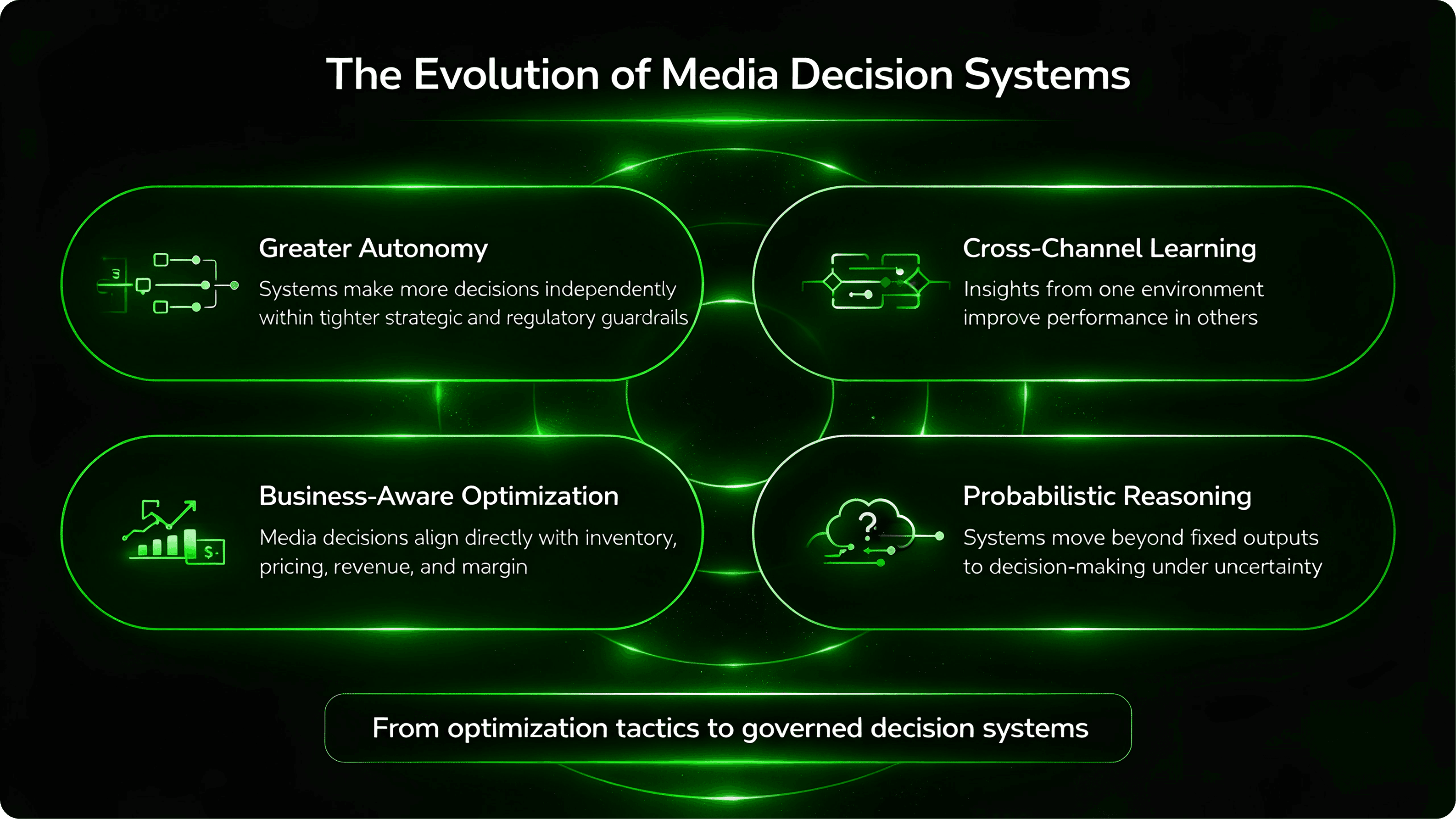
Future media decision systems are likely to evolve along several dimensions:
• Greater autonomy with tighter governance, where systems operate with increased decision freedom but within clearly defined strategic and regulatory boundaries.
• Cross-channel learning, enabling insights and optimization logic developed in one environment to inform decisions in others.
• More explicit treatment of uncertainty, with decision systems incorporating probabilistic reasoning rather than point estimates of performance.
• Deeper integration between media and business outcomes, particularly in commerce-driven environments where advertising decisions directly influence supply, pricing, and revenue dynamics.
As these trends unfold, the central challenge for organizations will shift from choosing optimization tactics to designing and governing decision architectures. The ability to reason about how decisions are made - at scale, under uncertainty, and in real time - will become as important as the decisions themselves.
In this context, the invisible layer of micro-decisions moves from the background to the foreground, shaping the next phase of media performance management.



