
The CMO’s Agentic AI Playbook for 2026–2028
Published on
Executive Summary
Marketing between 2026 and 2028 will be defined less by creativity or channel mastery and more by decision architecture.
CMOs are operating in an environment where:
- Media systems are increasingly opaque
- Signals are incomplete, delayed, or probabilistic
- Costs are rising faster than efficiency gains
- Accountability expectations extend beyond revenue into sustainability, governance, and risk
Gartner notes that marketing leaders are increasingly constrained not by lack of data, but by inability to convert fragmented signals into timely decisions (Gartner, 2024).
At the same time, AI capabilities are shifting away from assistive tools toward agentic systems. AI that can plan, decide, act, and learn across complex workflows (McKinsey, 2024).
This convergence of decision pressure on one side and autonomous intelligence on the other creates both opportunity and risk. CMOs who adopt agentic AI without governance risk losing control. CMOs who avoid it risk structural inefficiency.
This whitepaper is designed to help CMOs:
- Understand the structural forces reshaping marketing
- Grasp what agentic AI actually is (and is not)
- Build a measured, phased transformation plan
- Prepare their organizations for new roles, skills, and accountability models
- Evaluate ROI through financial, operational, and environmental lenses
The CMO Landscape in 2026
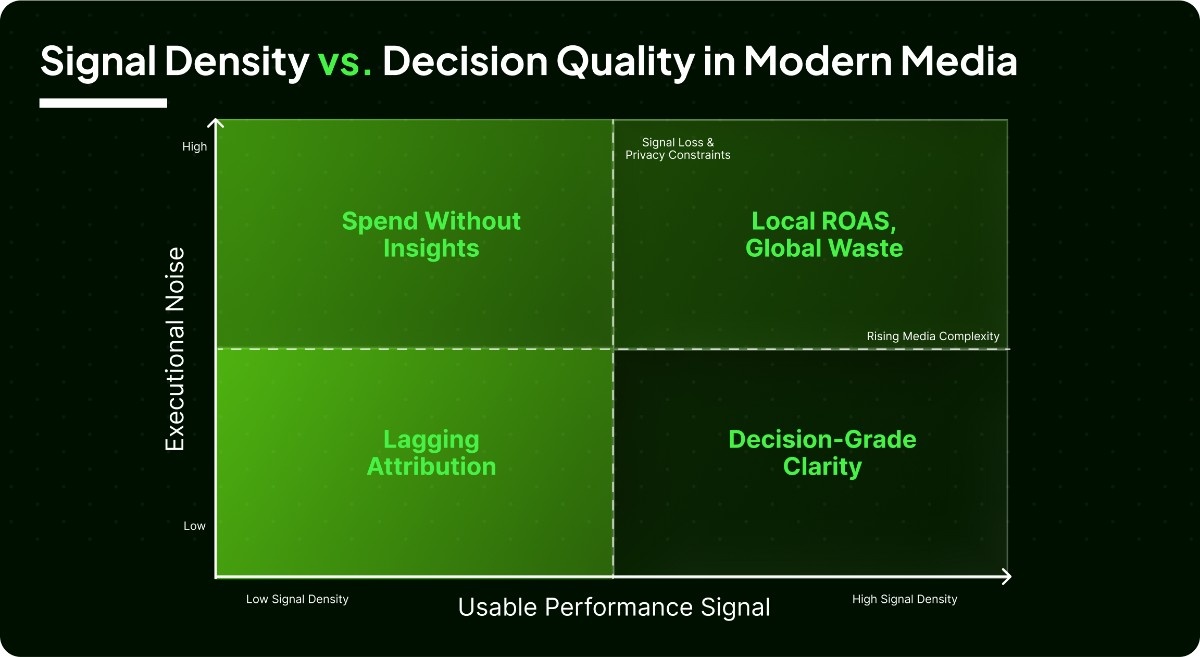
1. Marketing Has Entered a Low-Signal, High-Cost Era
For over a decade, marketing performance benefited from high signal density:
- Deterministic attribution
- Granular user tracking
- Rapid feedback loops
This environment no longer exists.
The World Federation of Advertisers estimates that up to 60% of digital advertising spend is inefficient, driven by poor media quality, MFA sites, redundant intermediaries, and weak signal utilization.
At the same time:
- CPMs continue to rise across major platforms
- Creative production volume has increased dramatically
- Media buying complexity has grown faster than organizational capacity
The result is a paradox: more activity, less clarity.
2. Attribution Loss Is Structural, Not Cyclical
Privacy regulation, platform policy changes, and consumer behavior shifts have permanently altered the measurement landscape.
Gartner predicts that 75% of the global population will be covered by modern privacy regulations, limiting deterministic tracking (Gartner).
This has forced marketing teams to:
- Rely on modelled attribution
- Accept higher uncertainty in performance reporting
- Make decisions with delayed or aggregated feedback
The implication for CMOs is profound: decision quality now depends on system design, not signal precision.
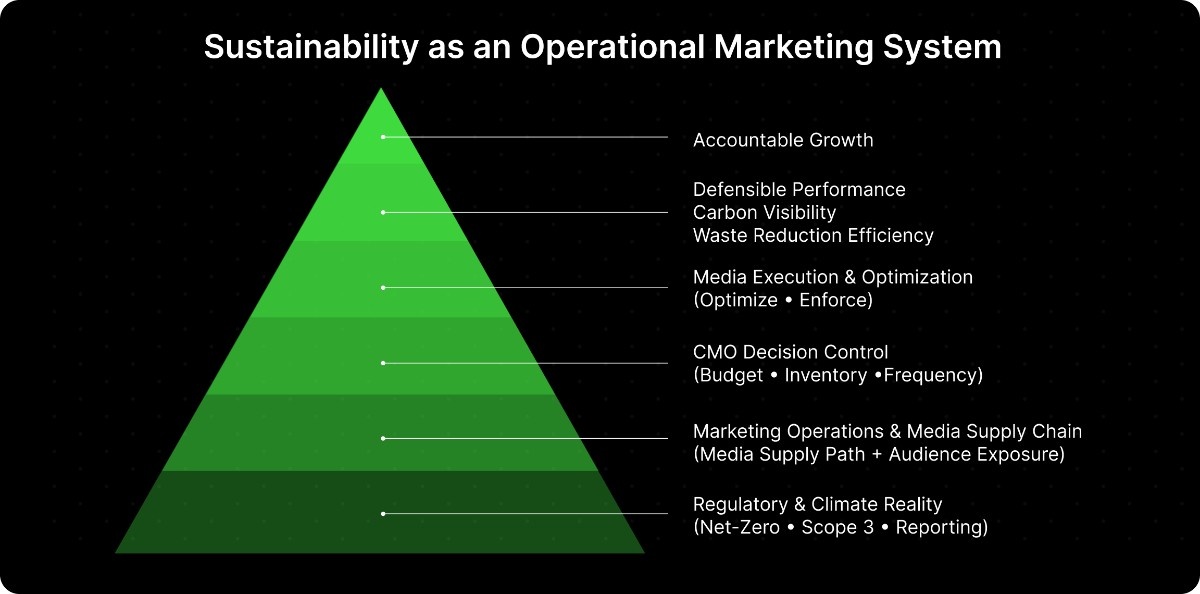
3. Sustainability Is Becoming an Operational Marketing Metric
Digital advertising is now recognized as a contributor to corporate Scope 3 emissions. Estimates place emissions at 3.5–7 gCO2e per impression, depending on format and supply path complexity.
Meanwhile, 107 countries have adopted net-zero targets, covering approximately 82% of global emissions (Net Zero Tracker).
This introduces a new dimension of accountability for CMOs:
- Media efficiency is now tied to environmental efficiency
- Wasteful spend has reputational and regulatory implications
- Sustainability teams increasingly rely on marketing data
The Agentic Advantage for CMOs
Agentic AI delivers value to CMOs not by accelerating isolated tasks, but by restructuring how decisions are made across the marketing system. Its advantage emerges at the level where human coordination, fragmented tooling, and delayed feedback loops currently constrain performance.
1. System-Level Efficiency vs. Local Optimization
Enterprise marketing stacks have expanded steadily over the last decade. According to ChiefMartec, large organizations now operate 15–25 marketing tools on average, many of which overlap in functionality while remaining loosely integrated.
This tool proliferation has created a structural problem:
- Each platform optimizes for its own metrics
- Decisions are made locally (channel, campaign, format)
- System-wide consequences are rarely visible in real time
Human teams are forced to act as the coordination layer—aligning tools, interpreting conflicting signals, and resolving trade-offs manually. As complexity increases, coordination cost grows faster than headcount or tooling investment.
Agentic AI shifts efficiency from local optimization to system-level coordination by:
- Continuously evaluating how decisions in one part of the stack affect outcomes elsewhere
- Reducing latency between signal detection and corrective action
- Minimizing duplicated effort across tools and teams
For CMOs, this translates into operational efficiency that does not rely on scale alone, but on better decision architecture.
2. Cross-Channel Intelligence
Traditional marketing optimization assumes that channels can be optimized independently and later reconciled at the reporting layer. This assumption no longer holds in a low-signal environment.
In practice:
- Audiences overlap across channels
- Creative fatigue propagates across platforms
- Budget shifts in one channel influence performance elsewhere
Agentic systems evaluate portfolio-level performance, treating the marketing operation as an interconnected system rather than a collection of channels.
This enables:
- Faster creative learning, as insights from one environment inform decisions in others
- More coherent budget reallocation, based on marginal returns across the portfolio rather than channel-specific ROAS
- Reduced duplication, by identifying redundant exposure and ineffective repetition
For CMOs, cross-channel intelligence reduces the risk of over-optimization in silos, which often leads to diminishing returns despite apparent channel-level success.
3. Waste Reduction as a First-Class Objective
Media waste has historically been treated as an efficiency issue rather than a structural flaw. However, waste now has financial, performance, and environmental consequences.
Research from Ebiquity indicates that eliminating MFA and low-quality inventory can reduce emissions by 20–40% while simultaneously improving attention and viewability metrics.
The challenge is not identifying low-quality supply; it is enforcing exclusions consistently at scale.
Agentic systems excel here because they:
- Apply exclusion logic continuously, not episodically
- Detect quality degradation faster than manual reviews
- Prevent regression when teams change or campaigns scale
By elevating waste reduction to a core optimization objective, CMOs can align cost efficiency, performance quality, and sustainability without relying on constant human intervention.
The Agentic Marketing Operating Model (2026–2028)
How decision authority, intelligence, and accountability evolve
Agentic AI adoption in marketing should not be viewed as a linear rollout. In practice, organizations evolve across distinct operating states, each defined by how decisions are made, who holds authority, and how intelligence is applied across the system.
These operating states are not strictly sequential. Large organizations may operate in multiple states simultaneously across regions, brands, or business units. However, long-term success depends on whether the core decision system matures coherently.
State 1: Governed Intelligence: Building Decision Clarity
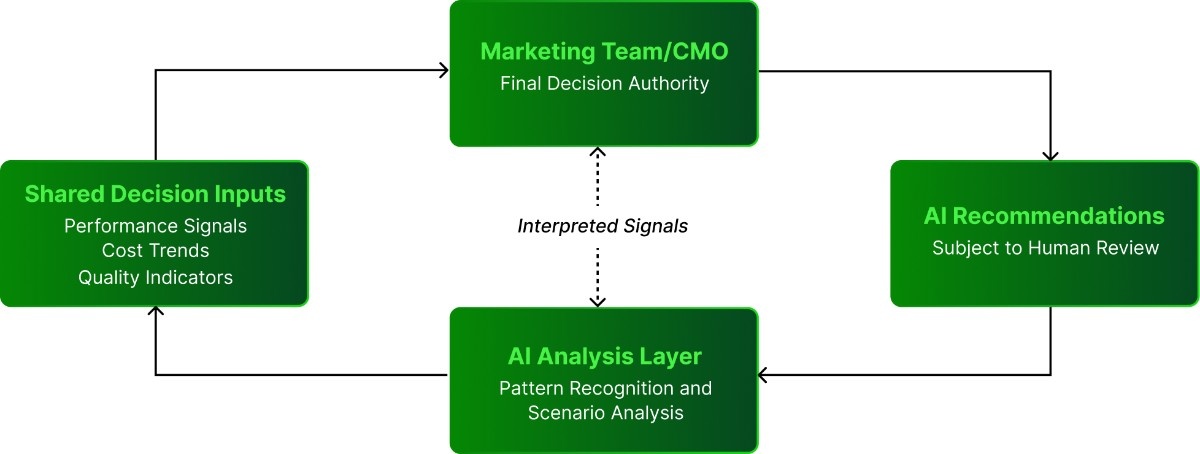
Defining Characteristic: AI informs decisions, but humans retain full authority.
In this operating state, agentic capabilities are used primarily to structure decision-making, not to execute it autonomously. The emphasis is on clarity, alignment, and trust-building.
What This State Looks Like in Practice:
1. Decision logic is made explicit
Rather than relying on implicit assumptions, CMOs formalize:
- Business objectives and constraints
- Performance trade-offs
- Brand and compliance boundaries
This creates a shared reference point for both humans and systems.
2. Signals are curated, not accumulated
Teams identify which signals genuinely influence outcomes and deprioritize those that add noise.
The goal is not more data, but more interpretable decision inputs.
3. AI outputs are reviewed, not followed blindly
Recommendations are evaluated by teams, creating feedback loops that improve both system learning and human confidence.
4. Carbon impact becomes visible
Environmental metrics are introduced into planning and reporting, establishing baselines without yet enforcing optimization.
Why This State Matters
Without this operating state:
- Autonomy lacks direction
- AI outputs are mistrusted or overridden
- Governance is added reactively after failures
This state builds the organizational muscle memory required for more advanced intelligence.
State 2: Coordinated Orchestration: Aligning Actions Across the System
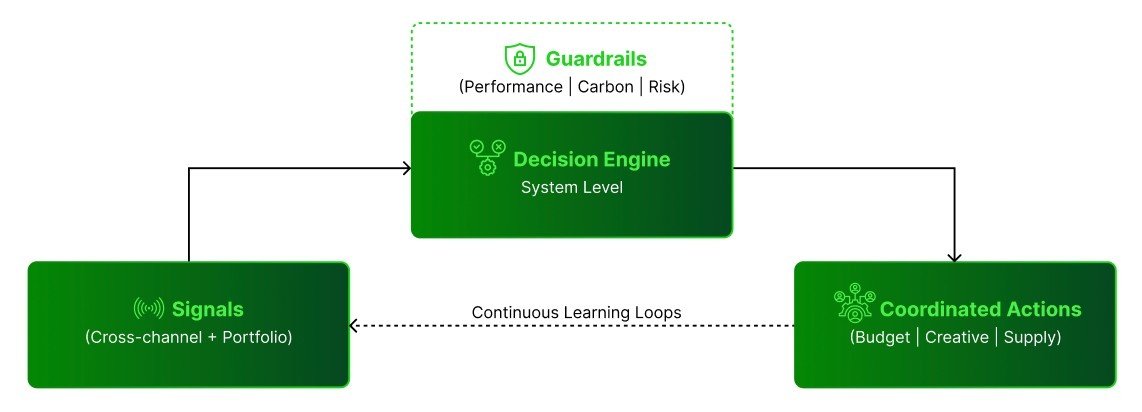
Defining Characteristic: AI coordinates actions across channels and tools within defined constraints
In this operating state, agentic systems move beyond recommendation into execution within guardrails. The system begins acting, but still under close human supervision.
What This State Looks Like in Practice:
1. Decisions are evaluated system-wide
Rather than optimizing channels independently, the system considers:
- Cross-channel performance interactions
- Learning velocity and marginal returns
- Redundant exposure and inefficiencies
2. Learning loops are continuous
Insights are not stored in reports but fed directly back into execution. The lag between performance signal and system response is dramatically reduced.
3. Human roles shift upward
Marketers spend less time on manual execution and more time on:
- Strategic intent
- Exception handling
- Interpreting emerging patterns
4. Carbon efficiency is actively optimized
High-emission inventory is deprioritized where performance trade-offs are acceptable, making sustainability a live decision variable.
Why This State Is Transformative
This is where:
- Tool fragmentation begins to collapse
- Operational friction reduces materially
- Performance becomes more stable despite weaker signals
However, it also exposes gaps in organizational readiness if governance and skills lag behind execution speed.
State 3: Controlled Autonomy: Scaling Intelligence with Accountability
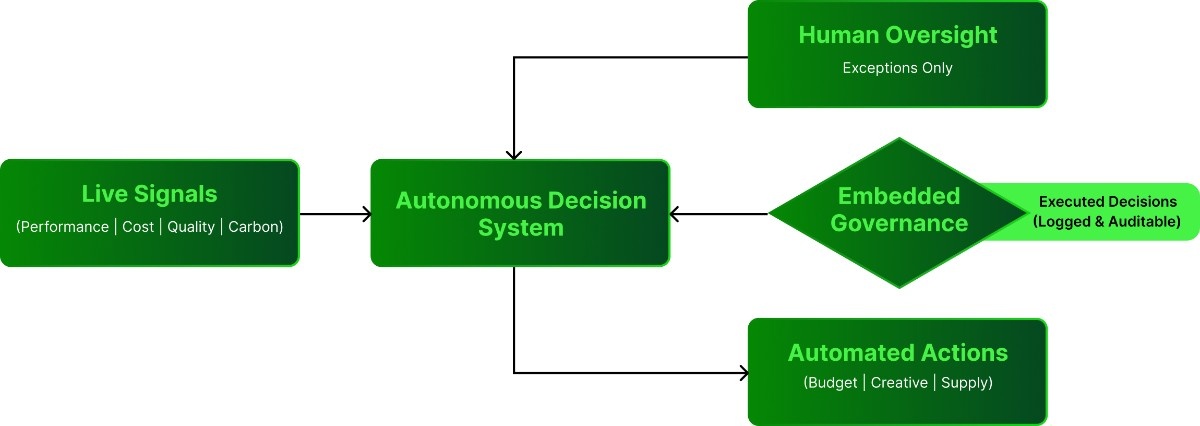
Defining Characteristic: AI executes routine decisions independently, humans govern outcomes and direction.
In this operating state, agentic systems handle the majority of operational decisions within pre-defined boundaries. Human involvement is strategic, not tactical.
What This State Looks Like in Practice:
1. Routine decisions are automated by default
These include:
- Budget reallocation within limits
- Creative rotation and fatigue management
- Supply quality enforcement
- Signal normalization and interpretation
2. Oversight is exception-based
Rather than monitoring everything, teams focus on:
- Deviations from expected behavior
- Constraint breaches
- Strategic inflection points
3. Governance is embedded, not manual
Brand logic, compliance rules, and risk thresholds are encoded directly into the system, ensuring consistency at scale.
4. Performance and sustainability converge
Efficiency gains increasingly benefit both financial outcomes and environmental impact, supporting enterprise-level reporting and accountability.
What Organizational Maturity Looks Like Here
- CMOs trust the system without micromanagement
- Teams focus on strategy, not coordination
- Performance volatility is reduced
- Marketing operations are defensible to boards, regulators, and stakeholders
New Skills & Roles in an Agentic–AI–Driven Organization
Agentic AI changes not just how marketing executes, but what marketing teams are responsible for.
According to the World Economic Forum, AI governance and oversight roles are among the fastest-growing job categories globally.
In marketing organizations, this manifests as a shift away from execution-heavy roles toward decision design, supervision, and accountability.
Emerging Roles Explained
1. AI Instruction & Logic Designers
These roles focus on defining how agentic systems interpret objectives, constraints, and trade-offs. The work resembles strategy and operations more than prompt writing.
2. Oversight & Escalation Leads
Rather than reviewing every decision, these roles monitor system behavior, investigate anomalies, and intervene when predefined thresholds are breached.
3. Carbon-Aware Media Planners
As sustainability becomes operational, planners are required to evaluate media not just on cost and reach, but on environmental intensity and long-term efficiency.
For CMOs, these roles represent a shift from “doing the work” to governing how work is done.
Governance, Safety & Accountability Principles
As autonomy increases, governance becomes a structural requirement rather than a compliance checkbox. Gartner predicts that by 2027, 30% of enterprises will mandate explainable AI, driven by regulatory pressure and internal risk controls.
In marketing, governance frameworks must address three core principles:
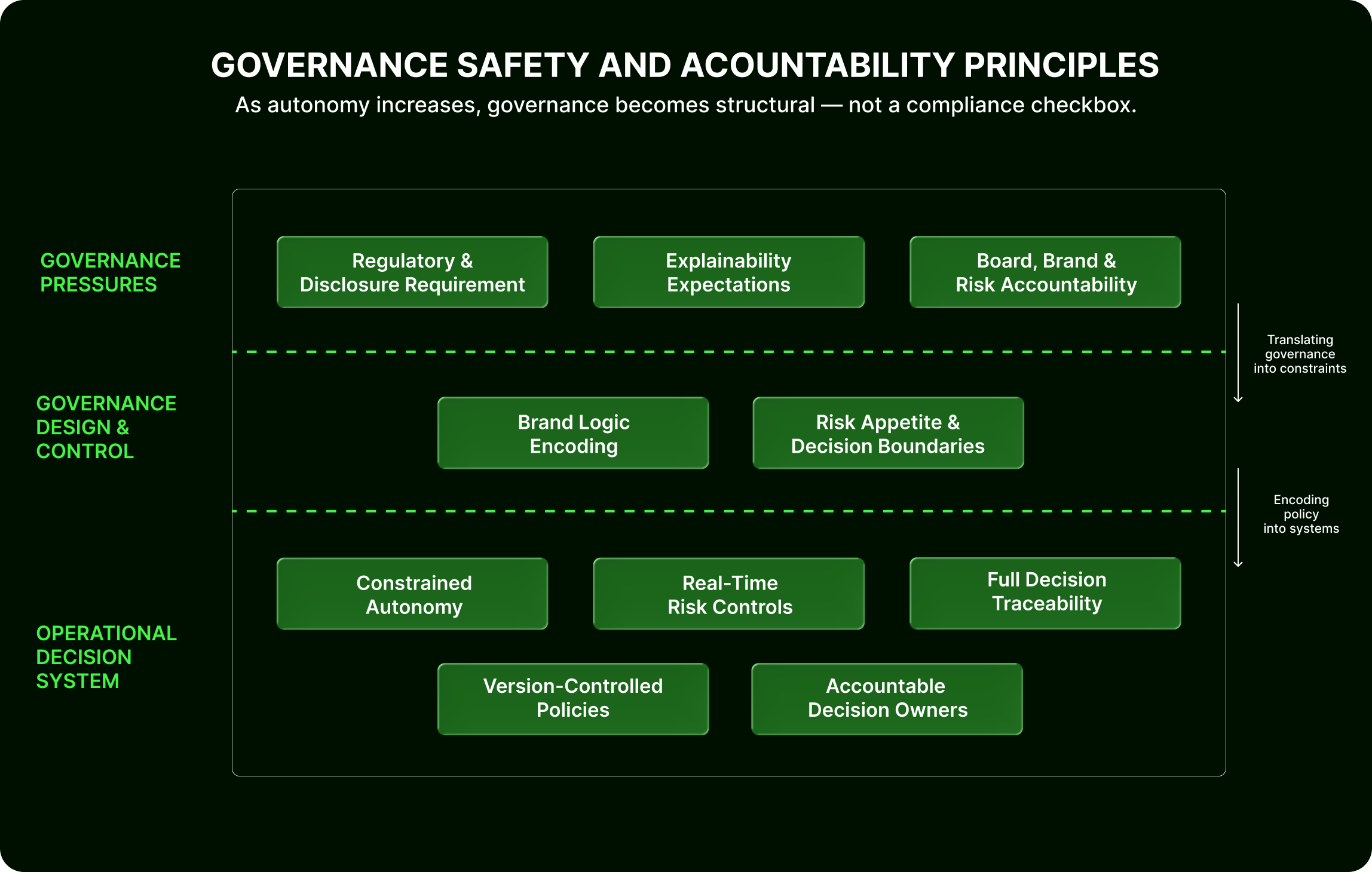
1. Explainability
CMOs must be able to understand why decisions were made, especially when outcomes deviate from expectations.
2. Brand Logic Encoding
Agentic systems must reflect brand values, tone, and risk appetite consistently across channels and markets.
3. Transparent Audit Trails
Decisions should be traceable for internal review, regulatory scrutiny, and board-level accountability.
Effective governance does not slow systems down; rather, it enables trust at scale.
Budgeting & ROI for Agentic AI
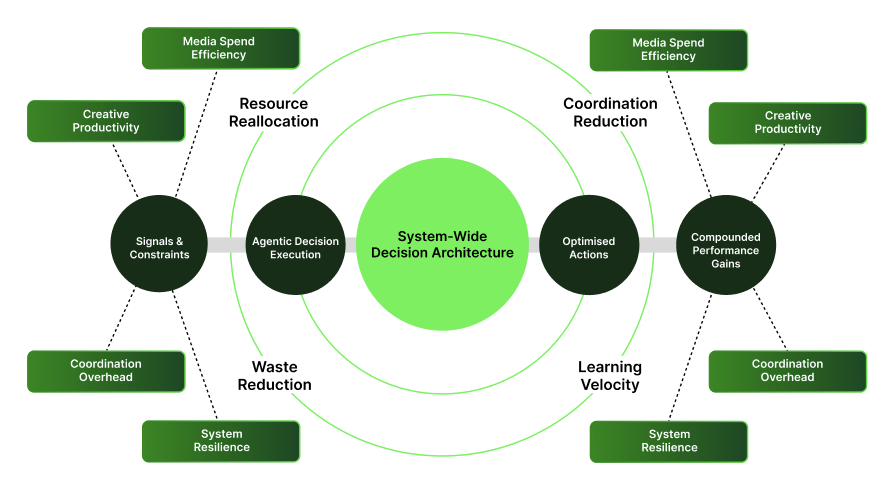
The financial case for agentic AI is frequently misunderstood as a cost-saving argument. In reality, its value lies in reallocating effort and spend toward higher-leverage decisions.
PwC estimates that AI can improve marketing productivity by 20–30% when deployed system-wide, rather than in isolated use cases.
ROI accrues from multiple sources:
- Reduced inefficiencies, through consistent quality enforcement
- Faster learning cycles, shortening the time from signal to action
- Lower coordination costs, as systems handle orchestration
- Improved resilience, stabilizing performance under signal uncertainty
For CMOs, this reframes budgeting away from “AI spend” toward decision efficiency as a strategic asset.
From Marketing Execution to System Stewardship
Between 2026 and 2028, marketing leadership will be defined less by executional excellence and more by the ability to design and govern intelligent systems. As signals weaken, channels fragment, and accountability expectations expand, CMOs will increasingly be judged on how well their decision architecture holds under scale.
Agentic AI represents a shift from isolated automation to coordinated decision-making, where planning, execution, optimization, measurement, and governance operate as a single system rather than disconnected functions.
Climaty AI reflects this shift through a multi-agent infrastructure where distinct agents handle briefing, audience intelligence, planning, execution, creative iteration, performance monitoring, analytics, competitive intelligence, and governance. Each agent owns a specific decision domain, while operating under shared objectives and guardrails. This structure enables autonomy without fragmentation and scale without loss of control.
In this model, the role of the CMO evolves decisively:
- From managing tools to designing decision logic
- From reviewing dashboards to overseeing system behavior
- From optimizing outputs to governing outcomes
Agentic AI does not remove human judgment from marketing, but elevates it by concentrating leadership attention on intent, accountability, and long-term value creation.
The CMOs who succeed in the coming years will not be those who automate the most, but those who build systems they can trust to think, act, and learn at scale.



