
Programmatic at the Edge: Efficiency and Intelligence in Modern Ad Buying

Published on
Executive Summary
Programmatic advertising has become the dominant model for digital ad buying, powering nearly 90% of global display ad spend in 2025. Studies indicate that between 40% to 60% of every programmatic dollar can disappear into the ad-tech supply chain before an ad even reaches a consumer. The result is budget drag, degraded performance, and unnecessary compute that increases carbon load.
Programmatic At The Edge is moving decision-making closer to impression delivery and injecting real-time intelligence into bidding and placement. The four aspects of this programmatic vision include Intelligence, Operational, Competitive and Sustainability, with the primary objective being efficiency plus intelligence.
Introduction: How Programmatic Works
1. Why Marketers Should Care
Most of your digital budget flows through programmatic infrastructure. Automated programmatic channels account for roughly 90% of global digital display spend, and in the US, programmatic represents more than nine in ten display dollars. That puts your reach, price discovery, and attribution squarely on how well the underlying mechanics perform.
Every auction affects outcomes. Who sees the ad, what you pay for a qualified impression, and whether that exposure converts are functions of bidder responsiveness, targeting precision, and supply-path quality. When the chain is leaky or mis-targeted, spend is absorbed without producing results.
Treat programmatic as a controllable system. Track and tune timeout rate, non-viewability, MFA exposure, and opaque hops. Enforce supply-path and brand-suitability policies, raise working-media share, protect ROAS, and route more budget to verified, viewable, contextually suitable impressions.
2. The Core Flow of Programmatic
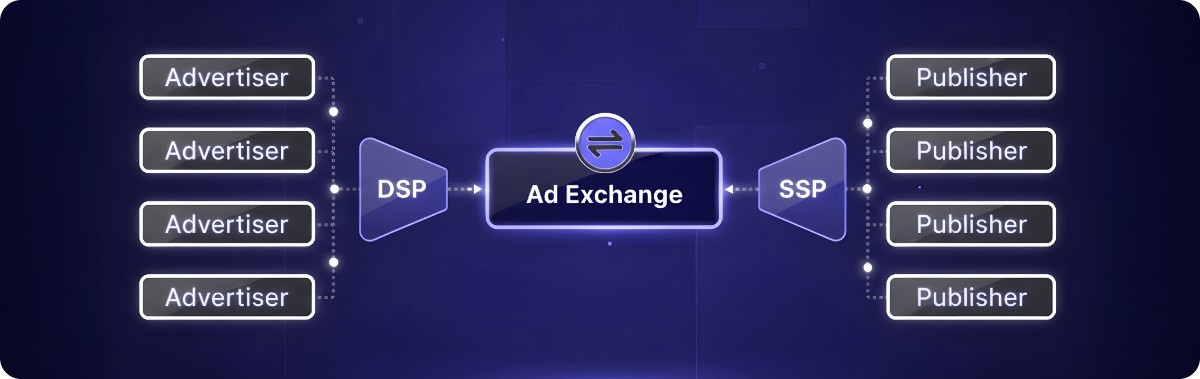
Programmatic advertising involves a set of interconnected platforms that manage the flow of ad inventory from publishers (sellers) to advertisers (buyers) in real-time. Its core components include:
I. Ad Exchange:
These are digital marketplaces where impressions are auctioned in real-time to the highest bidder. An ad exchange serves as a neutral trading platform connecting supply and demand, much like a stock exchange matches sellers and buyers of securities. When a web page loads and an ad slot is up for sale, the exchange conducts an instantaneous auction among eligible advertisers. The exchange's role is to match publisher supply with advertiser demand in a fair, efficient manner.
II. Supply-Side Platforms (SSPs):
SSPs are tools used by publishers to manage and monetize their ad inventory across multiple exchanges. An SSP automates the sale of impressions, letting a publisher push its available ad slots into auctions with control over pricing and preferences. The SSP software lets publishers set floor prices, block unwanted advertisers or content categories, and choose which exchanges or marketplaces to participate in. Modern SSPs also perform functions like ad quality filtering and enforcing the publisher's rules (e.g., brand safety, ad formats) before an impression is auctioned.
III. Display-Side Platforms (DSPs):
DSPs are the buying-side platforms that advertisers use to purchase ad impressions programmatically. A DSP provides advertisers with an interface to set up campaigns: specifying targeting criteria, budgets, bids, and creative assets, and then executes those buys in real time across multiple exchanges. The DSP also provides reporting so marketers can track campaign results. In practice, the DSP is where advertisers plug in their data and objectives, and the system's algorithms decide which impressions to buy and at what price, within milliseconds during each auction.
IV. Data Management Platforms (DMPs) and Customer Data Platforms (CDPs):
These systems provide the data backbone that makes programmatic "smart." A Data Management Platform (DMP) is a centralized database that collects, stores, and organizes large volumes of audience data from various sources. Marketers and publishers use DMPs to aggregate data such as website visitor behavior, CRM customer profiles, third-party demographic or interest data, etc. The DMP can then generate audience segments that can be fed into a DSP for targeting.
Customer Data Platforms (CDPs), which focus on unifying first-party customer data for marketing, have also become integral. These data platforms deliver audience insights, contextual information, and behavioral signals that enable DSPs to bid more intelligently. DMPs/CDPs fuel the programmatic process with targeting intelligence and help ensure the right ads reach the right people.
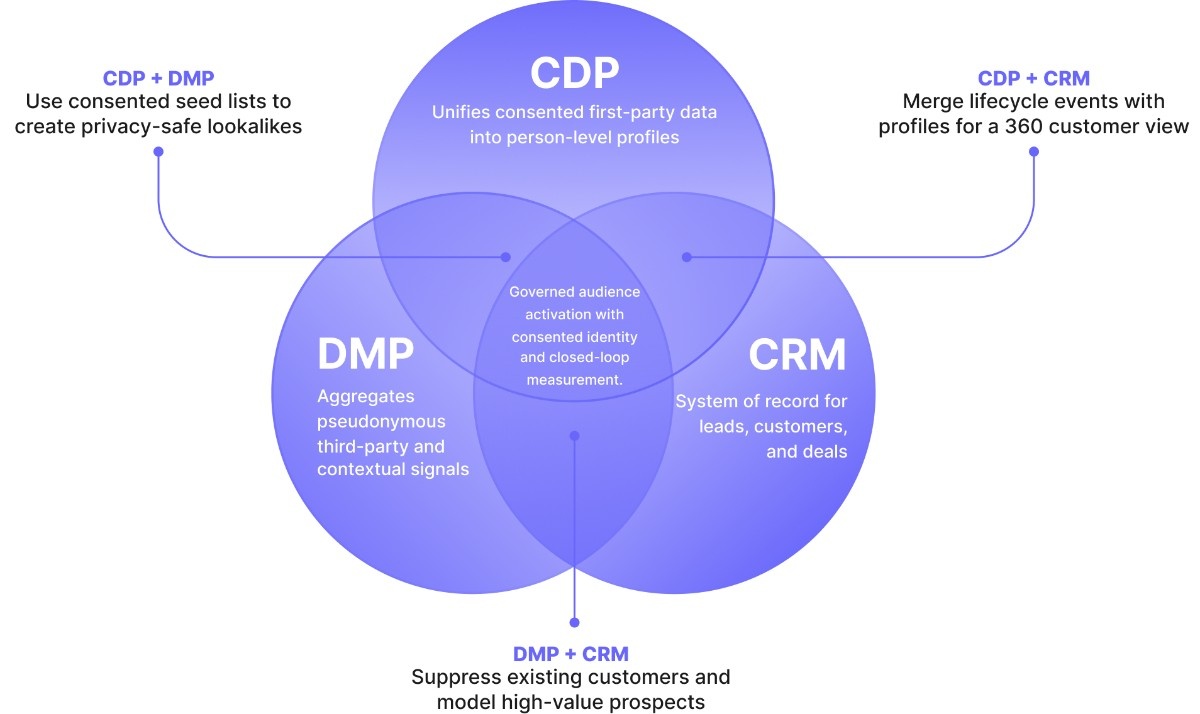
Fig: CDP, DMP, CRM: Roles and Overlaps
V. Auction loop:
What truly sets programmatic apart is the ability to transact on each impression in real time. When a user visits a website or opens an app that has programmatic ads, the following happens within a fraction of a second: publisher's SSP sends the impression details to an ad exchange -> exchange broadcasts bid request to connected DSPs -> evaluation of advertiser's targeting criteria and bid price -> bids sent back to exchange -> highest bidder is selected -> winning DSP's ad is displayed to user. (all within ~100 ms budgets common to major exchanges) DSPs effectively have only ~80-100ms to receive the callout, compute a bid, and reply, requiring both speed and intelligence, and thus arises the need for bidding "at the edge".
How is Programmatic at the Edge?
As programmatic advertising matures, the industry is looking for ways to make it smarter, faster, and more cost-effective. Programmatic intelligence pushes decisioning and data processing closer to impression delivery, replaces preset heuristics with per-impression inference, and exposes full-path economics so budget owners know where every rupee or dollar goes.
1. Defining Programmatic Intelligence
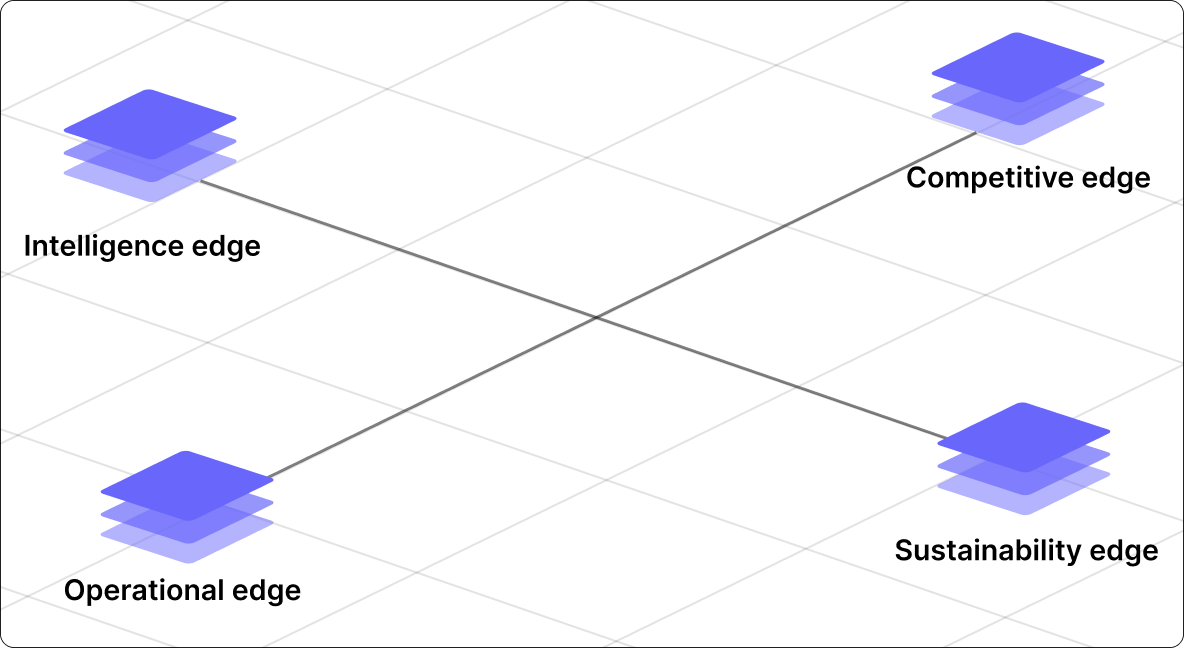
There are four advancing sectors in programmatic advertising, each providing a competitive advantage:
I. Intelligence edge:
Models score each bid request for context suitability, and expected value; set the price, choose the creative, and select the route in real time. Feedback loops retrain allocation continuously so pacing, frequency, and inventory mix self-correct at impression level.
II. Operational edge:
Low-latency bidders and shorter supply paths reduce network hops and timeout loss inside sub-200 ms auction windows. Co-location with exchanges, QPS controls, and lightweight creatives increase bid eligibility and render rates.
III. Competitive edge:
Reduce fee leakage, IVT, and MFA to raise working-media share so more budget reaches viewable human impressions. Precision decisioning and SPO reallocate toward high-propensity, high-attention inventory, lifting conversions per dollar and compounding as models learn each cycle.
IV. Sustainability edge:
Carbon-aware bidding prices estimated gCO2e into the objective alongside CPA or ROAS targets. Routes with lower emissions intensity and higher attention are favored. Residual emissions can be offset with certificate-backed workflows.
Programmatic Intelligence
2. Why It Matters Now
In traditional programmatic advertising, marketers lack full control over real-time bidding, data usage auction dynamics. This raises a push for programmatic efficiency and intelligence to several converging factors:
I. Intelligence-Rich Marketing Ecosystems:
Modern marketers now operate in data-rich environments with abundant first-party data and real-time signals from consumers. It's no longer enough to run basic automated campaigns; marketers need systems that can ingest streams of behavioral data, contextual data, and audience insights, and act on them in the moment. This approach allows leveraging such intelligence instantly in bidding decisions rather than in retrospect.
II. Rising Consumer Expectations:
Today's audiences are not passive. Consumers expect the ads they see to be relevant, timely, and respectful of their experience. At the same time, there is growing public awareness of issues like ad overload, privacy, and sustainability. Poorly targeted or excessive ads can cause inefficiency and actively harm brand perception. Programmatic at the edge directly enables this by improving targeting precision and cutting down unnecessary ad deliveries.
III. Competitive Landscape and Advantage:
The programmatic advertising arena is highly competitive, and margins for advantage can be slim. As more brands invest in AI and data-driven marketing, marketers who adopt edge-driven, intelligence-rich, sustainability-aware programmatic techniques will gain both performance and reputational edges over those who don't. On the performance side, an advertiser who manages to deliver ads more efficiently can either dominate auctions or maintain share at a lower cost. On the reputational side, brands known for responsible marketing can win favor with consumers.
IV. Sustainability Pressures:
In the broader business context, there is mounting pressure from regulators, investors, and corporate leadership to demonstrate tangible progress on sustainability. Industry initiatives like Ad Net Zero have accelerated this awareness and regulatory bodies and investors are asking companies to disclose more information about their environmental impact, including the footprint of media and advertising operations. Thus, pioneering brands are proactively seeking solutions that let them measure and reduce the emissions from their digital ad campaign.
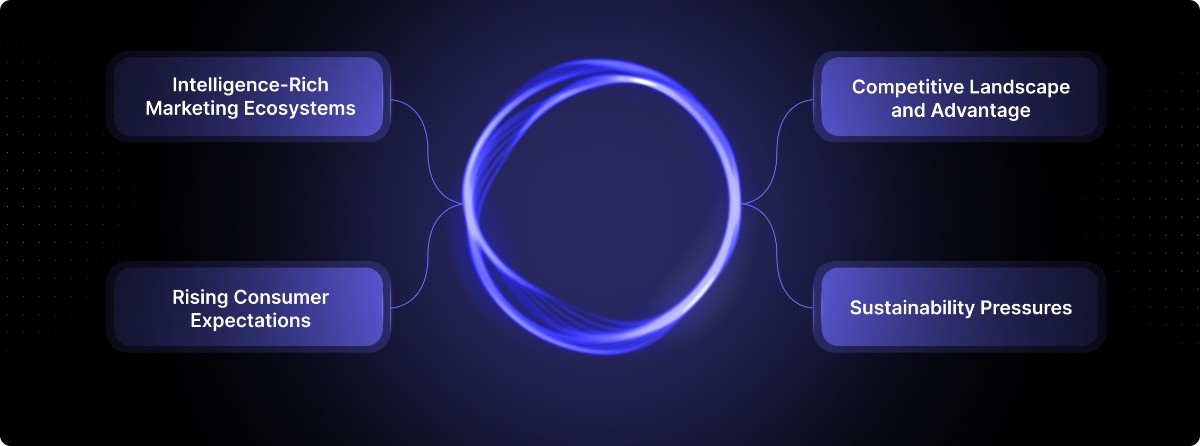
Driving Factors of Modern Programmatic
System Frictions and Efficiency Opportunities
While programmatic advertising unlocked incredible scale and automation, today's programmatic ecosystem continues to have a lot of friction and waste. The major categories of friction include:
1. Performance
Mis-targeting, non-viewable delivery, and invalid traffic suppress outcomes. Studies cite up to 70% of spend wasted on ads never seen by real people; bots and IVT consume a large share, with global ad fraud estimated at nearly 22% of spend in 2023. MFA sites siphon budgets with traffic of negligible value, reporting near 15% of programmatic spend in some portfolios. Excess frequency without cross-platform caps and poor contextual alignment further dilutes ROI.
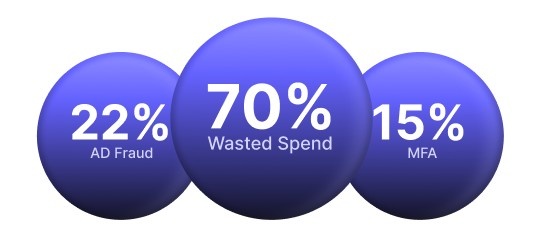
2. Financial
Analyses estimate that only 40-60 cents of each programmatic dollar reaches working media; the rest is absorbed by fees, duplication, and opaque markups. Duplicate supply paths generate multiple bid requests for the same opportunity, increasing QPS, server cost, and buyer confusion. Opaque auction practices and take-rates obscure true publisher payout.
3. Operational
Multi-DSP operations, fragmented data vendors, and divergent optimization logics create overhead and latency in decision cycles. Teams duplicate setup, pacing, QA, and reporting across silos; frequency management and budget reallocation are inconsistent without centralized control.
4. Environmental
Each redundant bid request, verification hop, and heavy tag call increases data center compute and energy draw. Digital advertising's infrastructure consumes substantial energy; 1 million impressions has been benchmarked near 1 metric ton CO2 in some analyses, making wasted impressions an emissions liability as well as a budget leak.
Strategic Mandate for Advertisers and Agencies
In light of the friction points outlined above, programmatic performance and financial discipline have become a strategic mandate for advertisers and their agencies. Key drivers include:
1. Media inflation and budget pressure:
CPCs and CPMs have risen while many CMOs manage flat or reduced budgets; every non-working dollar crowds out growth investment.
2. CFO scrutiny:
Leadership demands provable ROI and transparency; supply-path leakage represents immediate headroom to fund outcomes without incremental spend.
3. Competitive leverage:
Advertisers extracting 10-20% more working media from the same budget gain share-of-voice and pricing power inside biddable markets.
Intelligence In Modern Ad Buying
Programmatic performance now hinges on impression-time decision quality. Intelligence replaces template automation with a learning control system embedded in the bidder and policy layers: per-request inference, causal measurement, and closed-loop learning under explicit brand and legal guardrails. Practical levers that raise working-media share and lower effective CPA include:
1. Predictive propensity and value:
ML models score each impression for probability of click, conversion, or downstream revenue, integrating user state, context, device, and time signals to price bids accordingly. This replaces blunt segment averages with per-opportunity utility estimates.
2. Contextual and semantic controls:
NLP and computer vision analyze page or stream content to enforce brand suitability and improve relevance. Pre-bid contextual criteria avoid harmful adjacencies and select environments correlated with attention and conversion as third-party IDs recede.
3. Adaptive bidding and pacing:
Algorithms self-correct based on live performance telemetry: shifting bids, reallocating budgets, and re-weighting supply in minutes rather than days. Reported outcomes include double-digit CPA reductions and large delivery efficiency gains when AI governs optimization loops.
4. Human plus AI operating model:
Marketers codify goals, constraints, and creative guardrails; AI handles inference, allocation, and rapid micro-decisions. Teams concentrate on strategy, creative, and diagnostics while the system executes and logs explainable actions for audit.
Control Architecture:

Introducing Programmatic+ (Climaty AI)
1. Overview
Climaty AI's Programmatic+ is a result of re-engineering the programmatic buying process from the ground up with two core aims: maximize performance and integrate sustainability as a first-class objective.
2. Core Differentiators
NLP and computer vision analyze page or stream content to enforce brand suitability and improve relevance. Pre-bid contextual criteria avoid harmful adjacencies and select environments correlated with attention and conversion as third-party IDs recede.

I. AI-driven orchestration:
AI runs the optimization fabric: real-time inference per bid request, reinforcement across outcomes, and continuous rebalancing against KPI targets. Mid-flight drops or anomalies trigger autonomous adjustments with human-defined limits.
II. Smarter supply-path optimization:
Direct publisher integrations across web, mobile, CTV, and premium marketplaces reduce intermediaries, fees, and latency. Duplicate paths are de-prioritized. MFA suppression runs pre-bid using dynamic lists and model signals to avoid low-value domains.
III. Context-aware, brand-safe buying:
Pre-bid semantic analysis and strict inclusion/exclusion policies ensure placements align with category rules and brand tone. This improves viewability, attention, and suitability while eliminating adjacencies that create reputational risk.
IV. Sustainable intelligence:
Green CPM and impression-level carbon scoring incorporate emissions into the optimization objective. Programmatic+ can target a defined sustainability factor, for example, a 20% emissions reduction goal, while maintaining performance outcomes; residual emissions can be offset with auditable certificates.
3. Why It's Needed Now
I. Budget accountability:
Efficiency lifts convert immediately to working media; intelligence increases conversions per dollar in high-pressure environments.
II. Transparency and trust:
Buyers and publishers prefer verifiable, high-quality routes; Programmatic+ provides auditability across supply and decisions.
III. Regulatory and environmental expectations:
Ad Net Zero roadmaps and enterprise ESG targets require measurable reduction and reporting; carbon-aware bidding and automated offset workflows operationalize this inside the buying system.
IV. Market gap:
Traditional stacks emphasize scale; few integrate precision plus sustainability natively. Programmatic+ addresses both without sacrificing outcomes.
The Wave of Programmatic at the Edge
The advertising industry is on the cusp of a new era defined by intelligence and sustainability. To put the trajectory in perspective, we can consider a three-stage evolution of programmatic ad buying:
1. Past -> Automation:
The initial phase (roughly the 2010s) was about automation of media buying. The big leap was moving from manual insertion orders and direct buys to programmatic platforms and real-time bidding. Efficiency was gained in speed and scale: millions of impressions could be transacted in milliseconds. However, this phase was mostly about scale and convenience, not necessarily fine-tuned efficiency or intelligence.
2. Present -> Orchestration:
Programmatic is operating at the forefront today. Decisioning runs at the edge with per-request inference, policy guardrails, and full-path transparency. Programmatic+ scores propensity and context, sets price and creative, and selects direct routes within sub-200 ms windows while suppressing duplicate paths and MFA. Carbon-aware bidding and KPI instrumentation make performance a measurable, controllable system.
Climaty AI's vision with Programmatic+ positions it well for the present. By pioneering integrated sustainability and AI-driven orchestration now, it is essentially building the blueprint for how future-ready ad buying should operate. It acknowledges that efficiency, intelligence, and sustainability are not separate initiatives but deeply interconnected aspects of modern marketing success.
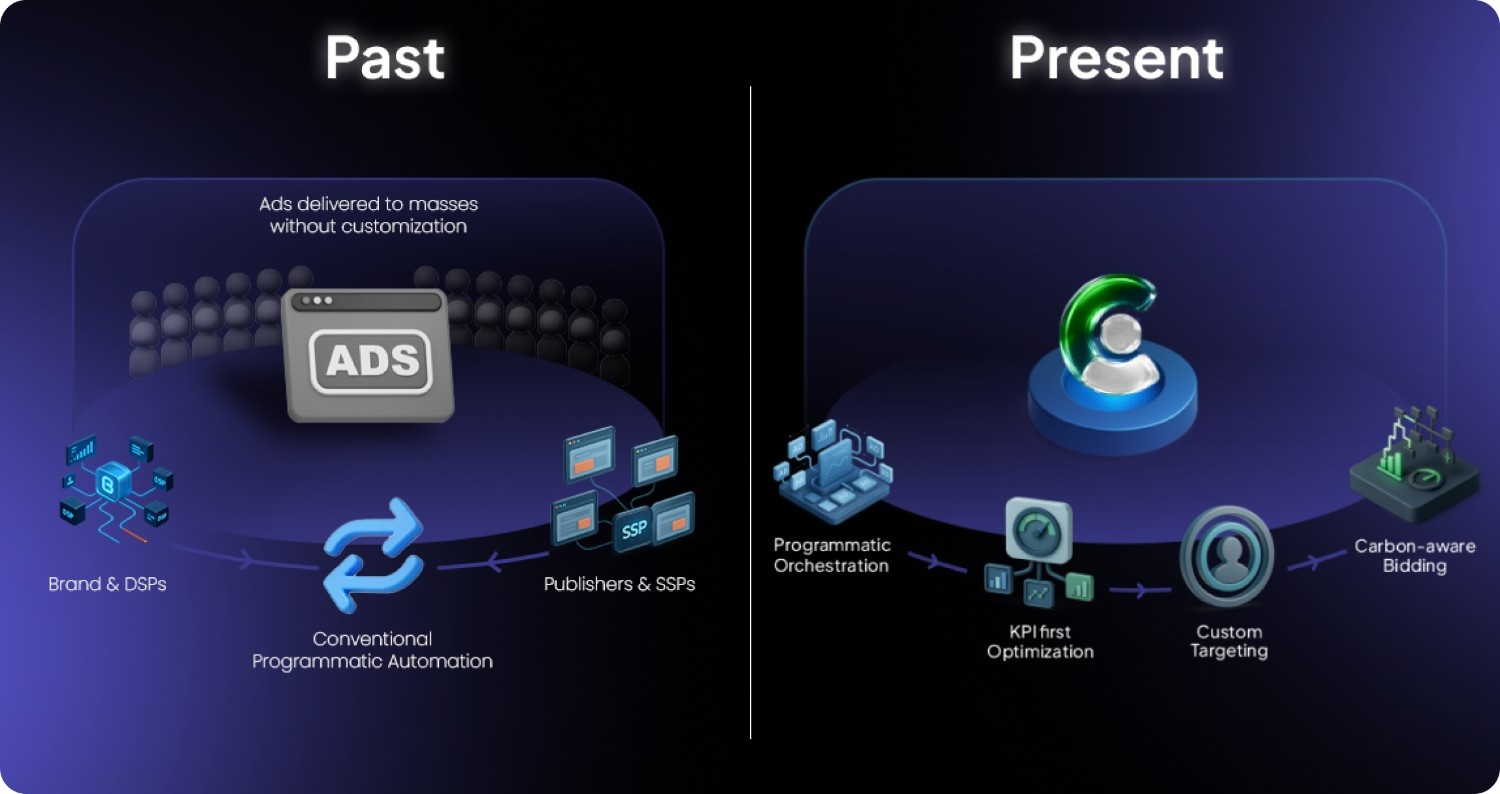
Programmatic Then vs Now: Automation to Present Orchestration
Conclusion
Programmatic advertising is at an inflection point. The new era of ad buying will belong to those who can combine efficiency, intelligence, and sustainability to achieve superior outcomes. Programmatic+ encapsulates this shift: advancing speed and data-driven decisioning while streamlining the supply path by removing non-value-added hops and accounting for broader environmental responsibilities.
Climaty AI's Programmatic+ operationalizes this approach with AI orchestration, direct supply, pre-bid semantic controls, supply-path intelligence, and Green CPM. For CMOs and performance leaders, the brief is straightforward: benchmark current leakage and viewability; pilot edge-aligned buying against those metrics; scale once deltas are statistically robust.
Get the competitive edge in programmatic+ - Book a demo now.
References
- Trustset Editorial Team, The Hidden Cost of Media: Data Quality Tax (June 2025) - inefficiencies in spend trustset.com
- StackAdapt, Role of AI in Programmatic RTB (May 2025) - stat on programmatic share stackadapt.com and AI advantages stackadapt.com
- AdExchanger, Attack of the Clones: Bid Duplication (Nov 2023) - on duplicate auctions and costs adexchanger.com
- BrandKnew (Bob Hoffman), 70% of Programmatic Ad $ Evaporate? (Dec 2021) - ANA/PwC finding brandknewmag.com
- Advertising Week (Phil Cowdell), Rethink CPMs for Sustainability (May 2024) - waste increases carbon dvertisingweek.com
- El Toro, Advertising Fraud 2025 (Mar 2025) - ad fraud at 22%/$84b and bot traffic stats eltoro.com
- The Ecologist (Emma Heley), Digital marketing's carbon footprint (Mar 2025) - 70% of spend wasted on unseen ads theecologist.org
- Eltoro/Emarketer, ANA study: 15% spend on MFA sites (2023) eltoro.com
- MediaMint Labs, MetaDSP future (Oct 2023) - complexity of multi-DSP ops mediamint.com
- McKinsey, Beyond Belt-Tightening (June 2023) - budget cuts 8-20%, CPC +20% mckinsey.com
- McKinsey, Investor mindset in marketing - find 10-20% savings to fuel growth mckinsey.com
- Quantcast, AI in Programmatic (Nov 2023) - 52% say AI key for DSP/SSP, predictive targeting defined quantcast.com
- Quantcast case studies - AI yielded +57% efficiency, -12% CPA vs competitor quantcast.com
- Fast Company (Ryan Peterson), Human + AI hybrid work (May 2025) - future of hybrid roles fastcompany.com
- Ad Net Zero - new guidelines requiring net-zero targets (June 2023) marketingdive.com
- Marketing Dive (Sara Karlovich) - Ad Net Zero & WFA developing carbon measurement frameworks marketingdive.com
- Shutterstock & Scope3 - 1M impressions ~1 metric ton CO2 sharethrough.com, 80% consumers favor brands cutting emissions sharethrough.com
- Climaty AI Press Release (Aug 2025) - Climaty AI launch, Programmatic+ defined prnewswire.com
- Climaty.ai website - features: Agentic AI agents climaty.ai, Direct publisher integrations climaty.ai, Green CPM and MFA-Free design climaty.ai, Q&A on measure-optimize-offset 360 approach climaty.ai



