
What Happens When Every Brand Has Its Own Personalized AI Marketing Brain
Published on
If you’re leading marketing today, chances are AI is already part of your stack.
It helps your team move faster, shortens creative cycles, and gives you more variations to test.
Yet, most weeks still feel the same.
You’re still:
- Deciding where to allocate budgets across channels that behave very differently
- Checking dashboards that explain results, but don’t guide your next decision
- Trying to personalize at scale without fragmenting your brand voice
AI is present, but it’s not carrying weight.
That’s because most marketing teams are using AI as extra hands, not as shared intelligence. Tools execute tasks, but the thinking still sits entirely with people in meetings, Slack threads, and mental models that never quite make it into systems.
This is where agentic AI enters the conversation.
Agentic AI is not about generating more outputs. It’s about building systems that can hold context, make decisions, and act autonomously within defined boundaries. In other words, intelligence that doesn’t just assist marketers but works alongside them continuously.
What’s emerging now is a different idea altogether:
What if your agentic intelligence lived inside your marketing infrastructure?
Why This Matters: The Shift From Generic AI Tools to Brand-Specific Agentic Brains
For a long time, AI in marketing was framed as a productivity unlock. Write faster. Test faster. Optimize faster.
That framing is no longer enough.
Personalization has crossed a threshold. It’s no longer a competitive advantage but the baseline. More than 70% of consumers now expect personalized interactions, and a similar percentage disengage when experiences feel generic or repetitive.
The problem isn’t that marketers don’t want to personalize. It’s that personalization, at scale, creates complexity faster than teams can manage it.
Every channel optimizes differently.
Every audience responds differently.
Every decision has second-order effects somewhere else in the funnel.
Generic AI tools help individual teams move faster, but they don’t resolve the decision conflicts between channels, objectives, and time horizons. They don’t understand what this brand is willing to trade off, and what it isn’t.
That’s why we’re seeing a shift from AI as a capability to AI as brand-specific intelligence.
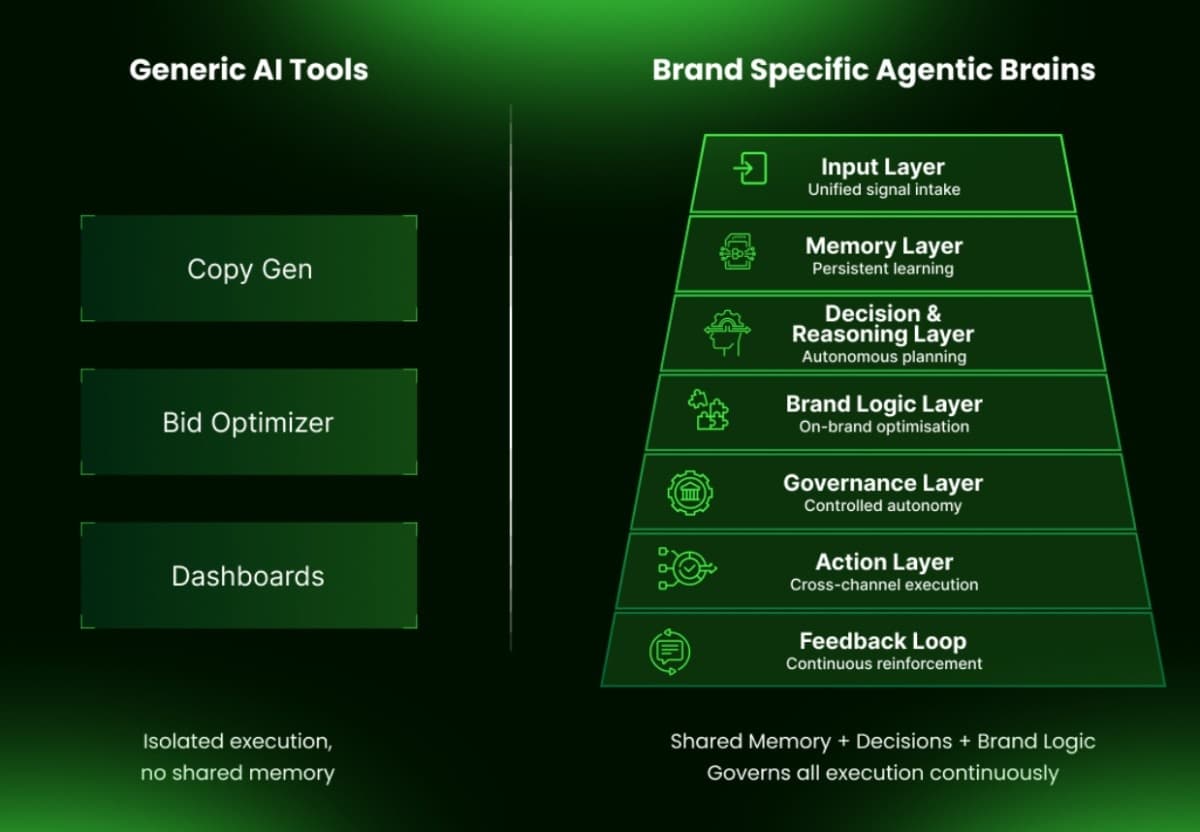
An agentic AI learns how your brand behaves, what your customers respond to, and which outcomes matter most for you. Over time, it becomes less about automation and more about institutional memory and judgment. It has:
01. Input Layer
It consolidates real-time signals from advertising platforms, web analytics, CRM systems, and commerce data alongside historical campaign outcomes and brand-defined constraints. Rather than operating from fragmented dashboards, decisions are grounded in a shared, continuously updated performance view.
02. Memory Layer
The system retains structured knowledge of past actions and outcomes. It records what worked, what failed, which trade-offs were made, and how different audiences responded under specific conditions. This creates institutional memory that compounds over time instead of resetting with each campaign cycle. Learning becomes embedded rather than episodic.
03. Decision & Reasoning Layer
At its core, the system evaluates goals across channels and time horizons. It balances short-term performance gains with long-term customer value, assessing second-order effects across the funnel. Decisions are made within defined objectives, reducing the friction that often arises when separate teams optimize independently.
04. Brand Logic Layer
Performance optimization is filtered through brand-defined intent. Positioning, tone, risk tolerance, and acceptable trade-offs are encoded directly into the decision process. This ensures that efficiency improvements remain aligned with long-term brand equity rather than drifting toward purely tactical gains.
05. Governance Layer
Autonomy operates within structure. Guardrails, escalation thresholds, and decision traceability are embedded directly into the system. This enables controlled autonomy, allowing actions to be executed confidently while preserving accountability and oversight.
06. Action Layer
Once decisions are determined, execution occurs across channels in real time. Budgets are reallocated, pacing and bidding adjusted, creative rotated, and audiences orchestrated dynamically. Optimization becomes continuous rather than reactive.
07. Feedback Loop
Performance signals, fatigue indicators, compliance triggers, and evolving customer behaviors feed back into memory. Each action refines subsequent reasoning, strengthening calibration over time. The system improves not just through data accumulation, but through structured learning.
That’s the real unlock, and the real moat.
The Current Reality: How Brands Are Using AI Today, and Where It Falls Short
It’s important to be honest about the current state.
AI adoption in marketing is undeniably high. Nearly 90% of marketers say they use AI in some form, often daily.
But depth of use tells a different story.
Most AI today is applied to:
- content generation
- bid optimization
- segmentation
- reporting acceleration
Useful? Yes. But largely on the execution level.
McKinsey estimates that AI adoption across marketing and sales typically delivers 10-20% improvements in ROI.
Meaningful gains, but not transformative ones.
You can see this gap clearly in real-world examples.
Zalando, a European online fashion retailer, for instance, used generative AI to compress creative production cycles from weeks to days and cut production costs by up to 90%.
LinkedIn post by Juozas Kaziukėnas
Coca-Cola used AI to generate tens of thousands of personalized video assets tied to cultural moments and individual consumers.
These are strong signals but they are still mostly about speed and scale, not autonomous decision-making.
Most brands today are experimenting at the edges. Very few have AI systems that own decisions end-to-end. That’s the gap agentic AI is beginning to fill.
What a “Personalized AI Marketing Brain” Actually Means
A personalized AI marketing brain is not a chatbot. It’s not a dashboard. And it’s not a bundle of features.
It’s an architectural shift.
At its core, a brand-level AI brain does three things continuously.
First, it remembers: Campaign outcomes, customer responses, trade-offs made, and signals. Learning compounds instead of resetting every quarter.
Second, it decides: Instead of merely suggesting options, the system can take actions like adjusting spend, pacing campaigns, adapting creatives, and reallocating focus in real time.
Third, it applies brand logic: Not just what performs well, but what aligns with the brand’s positioning, tone, risk tolerance, and long-term goals.
This is where agentic AI matters. According to McKinsey, nearly 40% of organizations are actively experimenting with agentic AI, and 23% are already scaling it in at least one function.
In marketing, this represents a move away from automation toward infrastructural intelligence that belongs to the brand, not individual tools or people.
How Day-to-Day Marketing Changes When Agentic AI Owns Decisions
The impact of a personalized AI brain isn’t dramatic at first. It’s subtle.
You notice fewer internal debates about which channel deserves more budget this week. Fewer reactive creative swaps driven by panic rather than insight. Fewer moments where teams optimize locally and undermine each other globally.
When channels stop competing with each other, it’s because the system evaluates outcomes holistically. It understands that a short-term performance spike may harm long-term value, and adjusts accordingly.
Salesforce reports that companies using AI to orchestrate experiences across channels see up to 25% higher customer retention than those managing channels independently.
Creative work changes too. Instead of feeling like a slot machine - rotate, test, discard - the system starts learning which ideas fatigue, which frames sustain attention, and which signals indicate diminishing returns.
Most importantly, decisions stop being episodic. Optimization happens continuously, not just when dashboards are reviewed. This is why Gartner estimates AI-driven decision automation can reduce manual marketing effort by 30–50% over time.
For leaders, that means less time firefighting and more time steering.
What Can Go Wrong (And Why This Isn’t a Tech Problem)
The risks of agentic AI in marketing are real but they’re rarely technical.
Poor data quality leads to poor decisions.
Lack of governance leads to off-brand behavior.
Unclear ownership leads to abandoned initiatives.
Gartner predicts that over 40% of agentic AI projects will be scrapped by 2027, largely due to misalignment between AI behavior and business strategy.
This is where we need to factor in trust. While consumers expect personalization, they also care deeply about transparency and control over how their data is used, and it makes one thing clear: agentic AI without intent and governance creates risk, not advantage.
How Marketing Leaders Should Prepare for Agentic AI
Preparing for a future where agentic AI plays a central role in marketing is not about rushing to adopt more tools. Most brands already have more software than they can meaningfully integrate.
The real preparation starts earlier with how decisions are defined, supported, and governed.
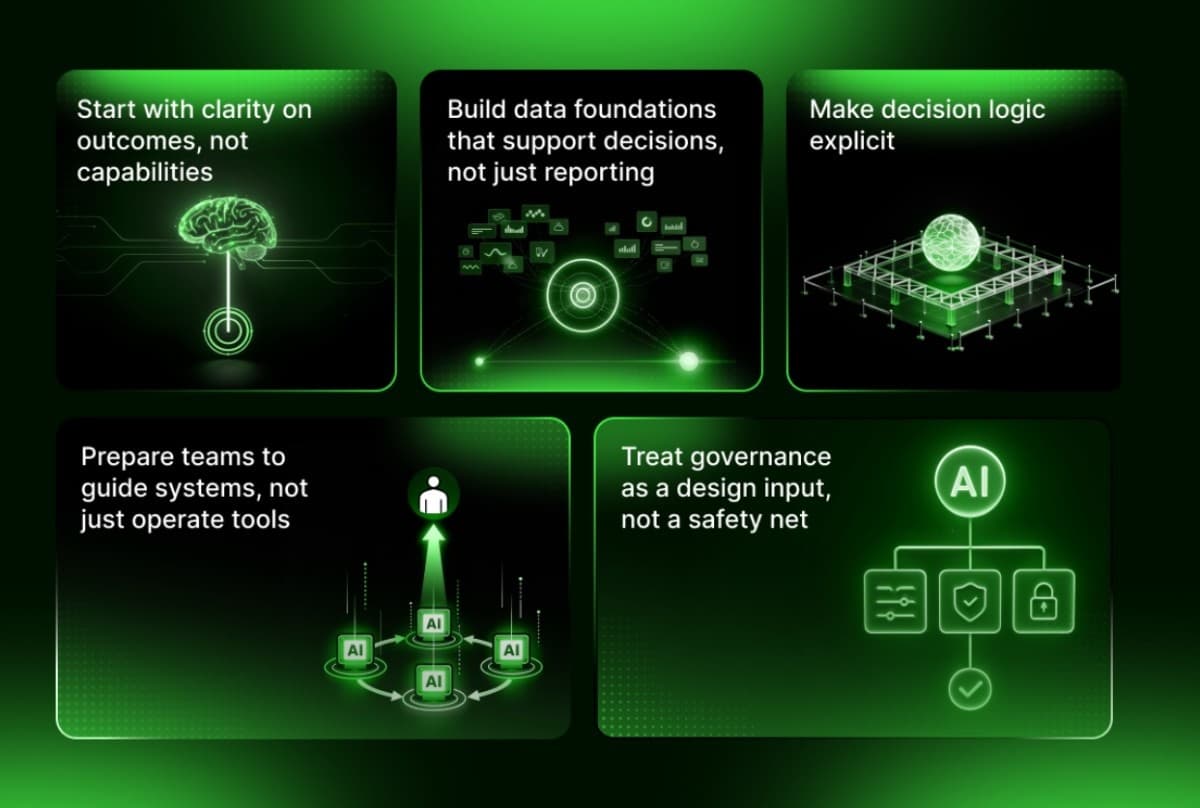
1. Start with clarity on outcomes, not capabilities
One of the most common mistakes with AI adoption is starting from what the technology can do rather than what the business needs to decide. Agentic AI will optimize exactly what it is asked to optimize. If the intent is vague, the results will be too, often performing well on paper while drifting from brand priorities.
2. Build data foundations that support decisions, not just reporting
Most brands don’t suffer from a lack of data, but from a lack of coherence. For agentic AI to work effectively, it needs a unified customer context, real-time signals, and enough historical depth to understand why past decisions were made, not just what happened.
3. Make decision logic explicit
Agentic AI forces teams to make their decision logic explicit: what trade-offs are acceptable, which brand constraints cannot be crossed, and when humans must step in. This shifts decision-making from an individual's intuition to structured, organization-wide intelligence.
4. Prepare teams to guide systems, not just operate tools
As execution becomes more automated, human effort shifts toward reviewing system behavior, refining direction, and stepping in when optimization conflicts with long-term goals. Judgment becomes more valuable, not less.
5. Treat governance as a design input, not a safety net
Autonomous systems work best when boundaries are built in from the start. Clear rules, escalation paths, and transparency make agentic AI more resilient, and more trustworthy, both internally and externally.
Taken together, these shifts reflect a broader change in how marketing operates. Intelligence moves from being individual and episodic to systemic and continuous. Brands that prepare for this thoughtfully won’t just adopt agentic AI more smoothly; they’ll build organizations that learn faster and make better decisions over time.
Climaty AI for Brand-Level Agentic Marketing Intelligence
Climaty AI is built for this inflection point.
Not as another optimization layer, but as an agentic marketing intelligence system that allows brands to encode how they think, not just what they do.
By combining real-time signals, governed autonomy, and brand logic, our Agentic AI stack enables marketing teams to move from reactive execution to continuous decision-making without losing control or accountability.
As personalization pressure increases and complexity compounds, that balance becomes decisive.
Takeaway
Almost every brand has access to similar AI capabilities.
What isn’t equal is:
- what those systems remember,
- what they optimize for,
- and whose values they reflect.
The brands that win won’t be the ones that “use AI the most.”
They’ll be the ones whose intelligence compounds quietly inside their marketing infrastructure.
Frequently Asked Questions
Will smaller brands need a personalized AI marketing brain?
Yes. Personalized AI marketing intelligence does not scale linearly with company size. Smaller brands often face the same personalization pressure as larger ones, but with fewer resources. Modular, agentic AI systems allow smaller marketing teams to build brand-specific intelligence earlier than they expect without large operational overheads.
Does a personalized AI marketing brain replace marketers?
No. Agentic AI in marketing does not replace human marketers. It shifts human effort away from manual execution toward higher-value work like strategy, judgment, creative direction, and governance. The AI handles continuous optimization while humans define intent and boundaries.
How is an agentic AI marketing brain different from current AI marketing tools?
Most AI marketing tools assist with individual tasks such as content generation, targeting, or optimization. A brand-specific agentic AI brain, on the other hand, retains memory, makes autonomous decisions, and acts continuously across channels, guided by brand logic rather than isolated prompts.
Is a personalized AI marketing brain only relevant for digital-native brands?
No. Brand-level AI intelligence benefits any organization with meaningful customer data, regardless of whether the brand is digital-first or not. Retail, D2C, B2B, and hybrid brands can all use agentic AI systems to improve personalization, decision-making, and consistency across touchpoints.
How long does it take to see impact from agentic AI in marketing?
Initial performance improvements from agentic AI marketing systems often appear within weeks or months, especially in areas like optimization and efficiency. However, the real value of a personalized AI marketing brain compounds over time as the system builds memory and learns from outcomes.
Is using agentic AI risky from a brand governance perspective?
Agentic AI becomes risky only in the absence of clear governance. When brand logic, constraints, and escalation rules are built into the system, personalized AI marketing intelligence can actually strengthen brand consistency rather than dilute it.
Do customers actually want AI-driven personalization?
Customers consistently express a preference for relevant, personalized brand experiences, as long as transparency and data responsibility are maintained. Brands that balance personalization with trust tend to see stronger engagement and long-term loyalty.
What is the biggest barrier to building a personalized AI marketing brain today?
The biggest blocker is not technology. Fragmented customer data and unclear ownership of AI decision-making remain the primary obstacles preventing brands from successfully implementing agentic AI marketing intelligence.



