
The Rise of Net-Zero Media Goals in 2026 Planning Cycles
Published on
Summary
Net-zero media is moving from pilot to baseline in 2026 planning. Brands are expected to show the emissions math next to CPA and ROAS, using shared methods that make media footprints comparable across channels.
In practice, that means tracking CO₂ per thousand impressions as a planning constraint, cutting wasteful routes and heavy assets, and reserving offsets for the residual after real reductions.
Agentic workflows help by applying the same rules you use for brand safety and fraud to emissions, with logs and policy versions for auditability. Treat carbon as another budget line, and you get a cleaner supply, steadier costs, and a plan you can stand behind in reviews and disclosures.
Why 2026 is poised to be the year of net-zero media
If you're locking FY25–26 budgets, you've probably already seen a new requirement on the briefing slide: the emissions math now sits next to your media goals.
This shift isn't happening in isolation. It's happening because the global context has changed.
Today, over 145 countries have announced or are evaluating net-zero targets, covering roughly 77% of global emissions.
Even more telling: 107 countries have already formalized their net-zero pledges, accounting for ~82% of global GHG output.
When the majority of the world operates under some form of climate-alignment mandate, "media emissions" automatically becomes part of the accountability layer. In markets like Europe, this is no longer aspirational. The European Climate Law makes net-zero legally binding by 2050, with a 55% reduction requirement by 2030, an aggressive timeline that pushes sustainability expectations into every business function, including marketing.
That's why 2026 is positioned as the year net-zero media becomes baseline planning behavior.
What Net-Zero Means for Digital Media
Digital media has a real, measurable footprint, and it's finally quantifiable in a way teams can work with.
A single ad impression can carry very different carbon weights depending on the format, file size, and supply path. Today, industry benchmarks show that digital advertising emits anywhere between 3.5–7g CO₂e per impression.
This range is the core reason standardized measurement matters. Without a shared method, planners can't compare tactics, channels, or formats on an equal footing. With standardized measurement, the media begins speaking the same carbon-accounting language the rest of the organization uses.
Net-zero for the media isn't about perfection, it's about measurable reduction where possible, and transparent handling of the residual.

Performance, Sustainability, and the New Quality Benchmark
For marketers, the useful shift is that sustainability now tracks with performance in observable KPIs: lower grams per impression often coincide with higher attention, stronger viewability, and steadier CPA.
When teams cut out low-quality or MFA-adjacent supply, the impact shows up in more than emissions. This is what's driving the shift in brief. It's no longer enough to optimize toward CPM or reach alone.
The carbon cost of a useful impression: 2026 triad (Visual)
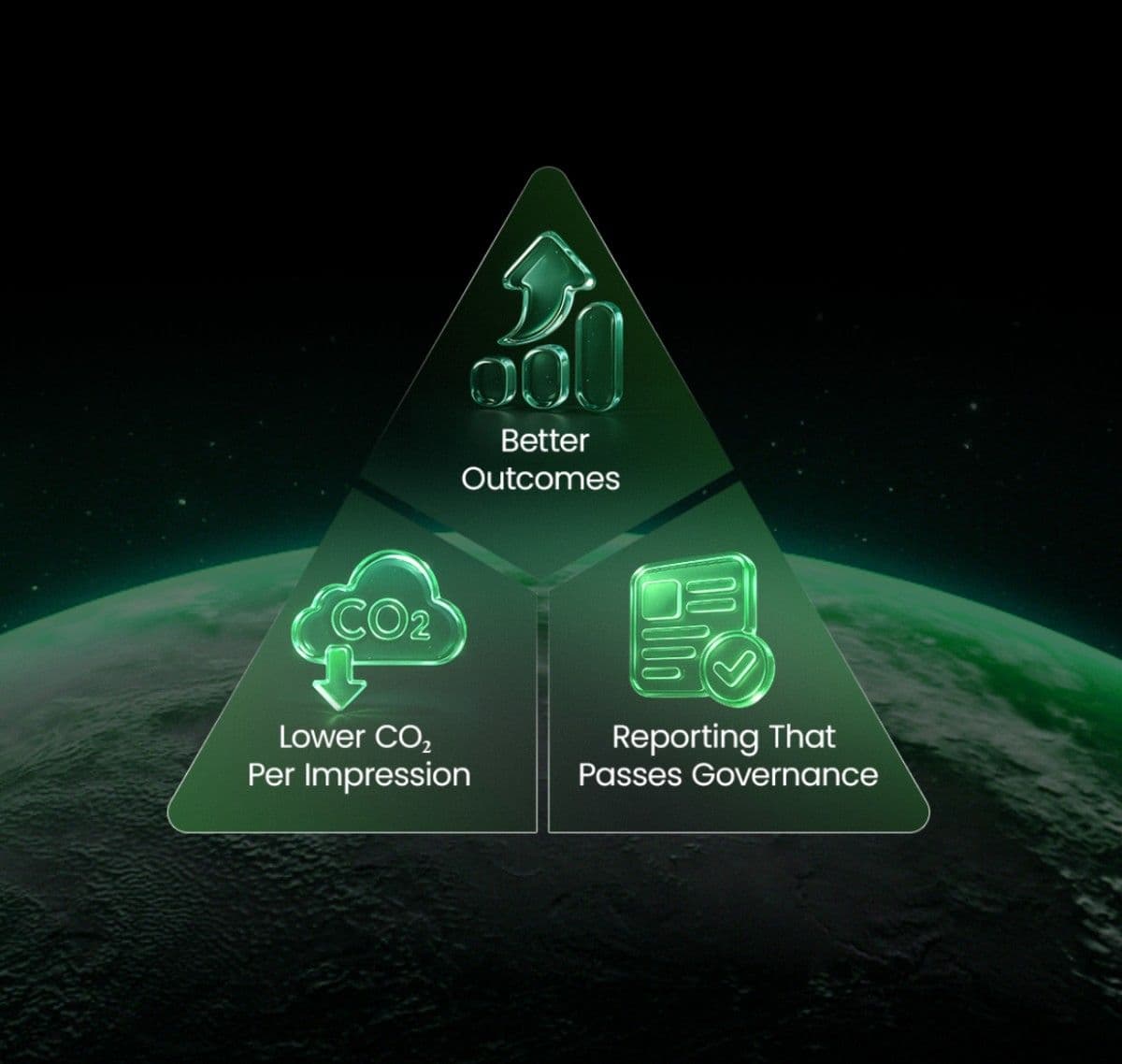
Carbon Cost per Impression: The New Comparative Metric
Once you treat CO₂ per thousand impressions as a planning metric, the tradeoffs become tangible.
When one placement emits 3.5 gCO₂e, and another emits 7 gCO₂e with no incremental lift, it gives planners a common unit to compare tactics and routes. Cleaner supply paths, right-sized creatives, and lighter formats don't remain limited to environmental gestures but become operational decisions that drive efficiency.
The result is a planning model where carbon is not an add-on, but an optimization lever that clarifies which tactics genuinely move performance.
From Intention to Action: The Weekly Loop You Can Actually Run
You do not need another pledge. You need a flow that teams can sustain. Treat carbon as a hard planning constraint alongside CPA and RoAS, and run the loop weekly so finance, sustainability, and media review the same board.
Climaty AI helps you do this in practice with per-impression emissions and a multi-view dashboard for shared visibility and Programmatic+ to prioritize premium, MFA-free, carbon-aware supply when you buy.
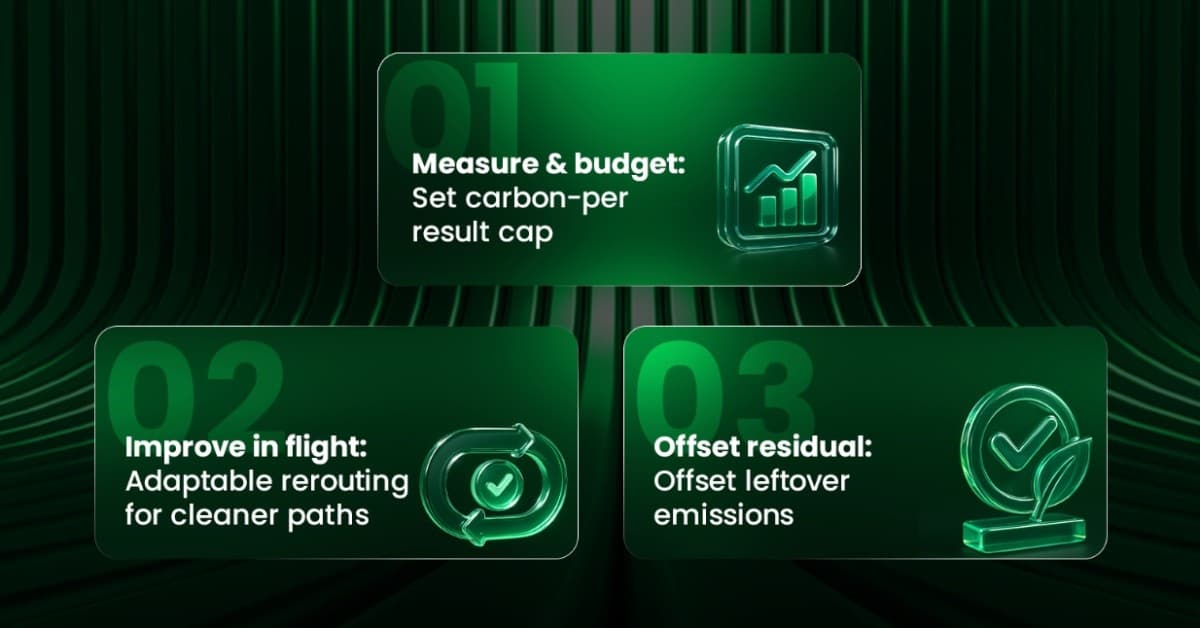
Measure and budget
- • Standardize on one method that maps to incorporate Scope 3 emissions
- • Put grams per impression and grams per outcome on the same board as CPA and ROAS. If your media stack reports performance elsewhere, mirror the emissions view in your BI so stakeholders review a single source of truth
- • Add a carbon budget next to media spend in the brief. Carry a grams-per-outcome guardrail into buying constraints and partner scopes
Improve in flight
- • Apply the quality rules you already use, now with a carbon lens. Prefer shorter supply paths, right-sized creative files, and verified placements
- • Set clear triggers to act. When grams per impression rise or early-hook quality falls, rotate creative, change routes, or redistribute weight
- • Document the rules and the exceptions so next quarter runs faster and more consistently across markets
Offset the residual
- • After reductions, calculate what remains and address it with high-quality credits
- • Publish what you retired and why. Keep credits as the final step, not the only step
How Automation Helps Without Tradeoffs
This is the software layer that applies the same rules at delivery speed, with evidence you can audit.
Pre-flight Checks, Before Spend
Emissions constraints sit alongside fraud and brand safety. Plans that exceed route length, file-weight, or eligibility limits are revised before spend to keep approvals clean and avoid late rework.
Climaty AI provides per-impression emissions and a multi-view dashboard, so the approval bundle can show what was checked and why it passed.
In-flight Controls, During Spend
Systems watch outcomes and grams per impression together. If a path looks cost-efficient but carbon-heavy or quality-poor, budgets shift to cleaner, verified supply.
Programmatic+ focuses on buying premium, MFA-free, direct publisher inventory and uses carbon-aware bidding to lower the footprint of the route while maintaining delivery.
Proof You Can Review Quickly
Changes and results are captured for weekly and quarterly reviews, with emissions and performance in one narrative.
Cross-channel analytics and per-impression views support governance and year-over-year disclosure.
How to frame 2026 plans
- • Put grams per outcome on the same line as CPA or ROAS so trade-offs are visible during planning, not after the flight
- • Treat supply quality and sustainability as the same lever. Removing wasteful inventory reduces emissions and improves real effectiveness
- • Write your residual policy now. Decide how you will handle the remainder, what standards you will accept, and how you will disclose it to stakeholders who expect audit-ready numbers
What Climaty AI Provides
Creator AI — throughput with control: rapid variants that inherit tone and required disclosures, with format and placement checks so freshness does not break compliance
Analytics AI — plain-language diagnostics: emissions per impression and per outcome alongside performance indicators, with flagged routes and suggested fixes, scoped to role-based access
Optimizer AI — safe adjustments: routine changes within thresholds run automatically; larger moves request approval with projected impact and rollback
Campaign Builder AI — faster planning: translates goals into executable plans that respect caps and suitability guidelines

Net-zero is Not a PR Goal. It is an Efficiency Goal
Net-zero works when it is treated as an operating discipline, not a headline. Use one source of truth. Measure grams per impression with CPA and ROAS, set a carbon budget, enforce routing and format limits, review in-flight signals against performance, and apply credits only to what remains after reductions.
Run this loop weekly so finance, sustainability, and media see the same numbers, and use automation to apply the rules pre-flight, steer spend in flight, and keep an audit trail that explains every change.
Do this consistently and you get cleaner supply, steadier costs, faster approvals, and a plan that holds up in governance review.
References
- 1. Ad Net Zero – Global Media Sustainability Framework (GMSF): https://adnetzero.com/wp-content/uploads/2024/09/The-Ad-Net-Zero-Global-Media-Sustainability-Framework-2024.pdf
- 2. Climate Action Target: https://climateactiontracker.org/global/cat-net-zero-target-evaluations/
- 3. ISBA – Responsible Media Guide: Sustainability: https://www.isba.org.uk/knowledge/responsible-media-guide-sustainability
- 4. IEA – Share of electricity consumption by data centre and equipment type, 2024: https://www.iea.org/data-and-statistics/charts/share-of-electricity-consumption-by-data-centre-and-equipment-type-2024
- 5. VCMI – Claims Code of Practice (April 2025, PDF): https://vcmintegrity.org/wp-content/uploads/2025/04/VCMI-Claims-Code-of-Practice-April-2025-Version-3.0.pdf
- 6. European Climate Law: https://climate.ec.europa.eu/eu-action/european-climate-law_en



