
The Invisible Architecture Behind High-Performing Campaigns

Published on
Summary
Most performance teams are doing more work than ever, but still can’t explain why performance swings, why reporting breaks, or why wins don’t repeat. That’s the tell.
You’re likely doing the obvious things already: producing more creatives, running more tests, tweaking budgets, living in dashboards. Yet many weeks still feel the same. You debate why one channel “won,” struggle to explain drops with no clear driver, and rebuild reporting because structure does not roll up cleanly.
The difference between average and high-performing campaigns is often not a better ad. It is the architecture underneath: clean inputs, shared context across channels, consistent structure, and feedback loops that turn activity into repeatable learning.
Why This Matters: Performance Has Become an Operating System Problem
Execution is increasingly automated, but the system is only as good as the structure it runs on. McKinsey’s 2025 Global Survey on the state of AI suggests AI usage is now mainstream: 88% of respondents say their organizations use AI regularly in at least one business function, even as many remain stuck in pilots and only about a third have started scaling
Gartner’s 2025 data and analytics trends describe how data and analytics are moving “from the domain of the few, to ubiquity,” which raises the cost of messy decisioning. BCG notes that the transformation gives marketing organizations new capabilities such as root-cause analysis, real-time personalization, and predictive decision making.
The Current Reality: Why Better Creative Still Produces Inconsistent Results
Most teams do not lack tools, they lack coherence. HubSpot’s 2026 State of Marketing page notes that 61% of marketers believe marketing is experiencing its biggest disruption in 20 years due to AI, and that 80% use AI for content creation while 75% use it for media production. Output is easier than ever, but learning is not.
Salesforce’s 2026 marketing research commentary adds a practical symptom: 69% of marketers still struggle to promptly respond to customers and 84% confess to running generic campaigns. Salesforce points to the root cause: “Siloed systems and poor data quality remain the top barriers” to AI-driven personalization.
What Campaign Architecture Actually Means
Campaign architecture is the operating structure that makes performance repeatable. It is how you standardize signals, keep channel decisions comparable, and connect creative learning to execution fast enough to stay ahead of fatigue.
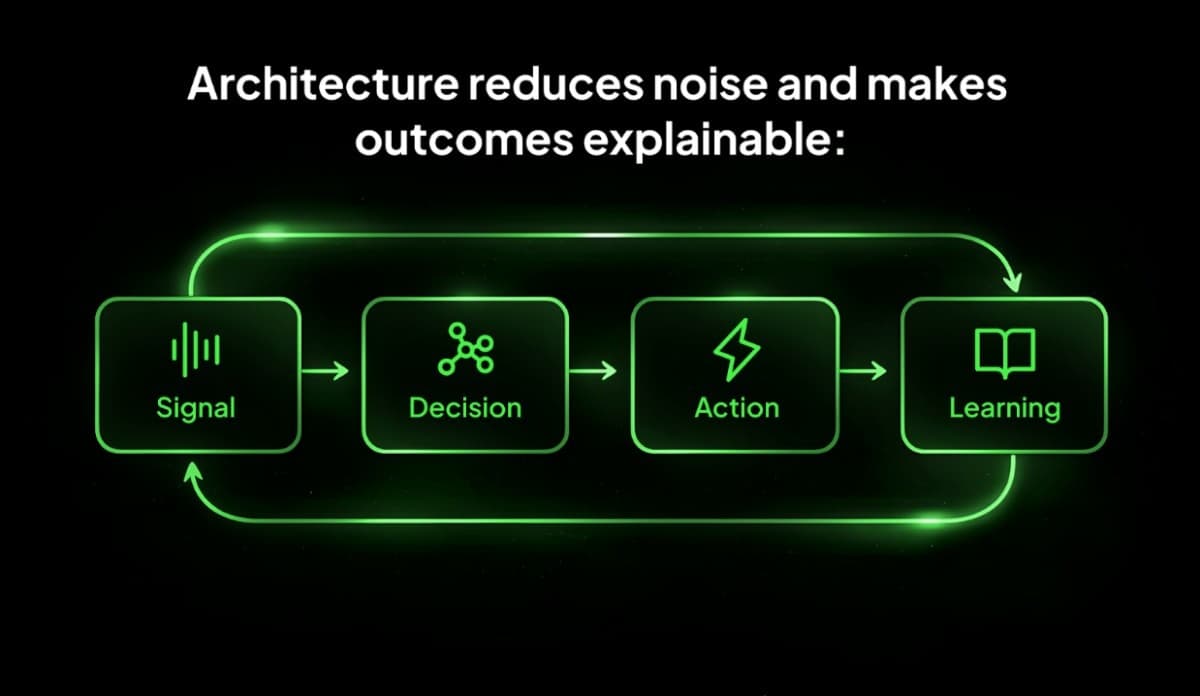
A simple way to think about it is this: architecture is everything that makes results explainable. It is the difference between “we ran tests” and “we can trust what the tests mean.” When architecture is strong, teams can answer three questions quickly: what changed, why it changed, and what to do next.
Visual suggestion: A simple “Signal → Decision → Action → Learning” loop, showing where architecture reduces noise.
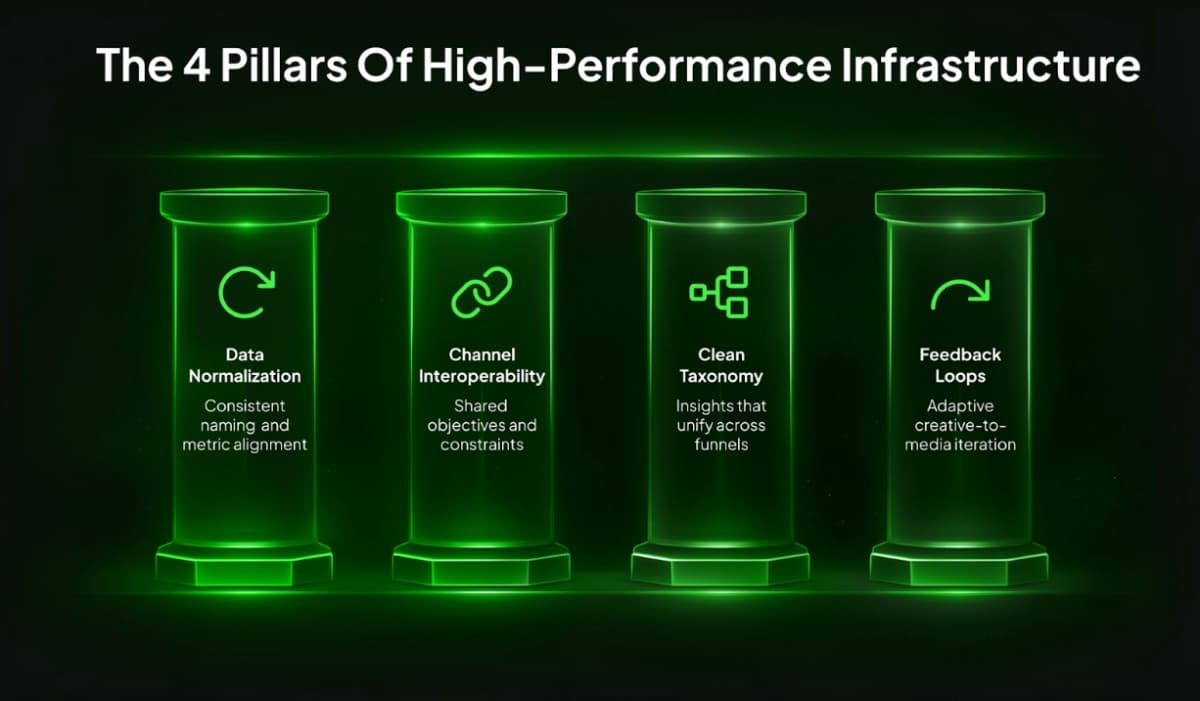
The 4 Pillars of High-Performance Infrastructure
- Data normalization: consistent naming, consistent conversion events, and aligned metric definitions across platforms so teams are not optimizing different truths
- Channel interoperability: shared objectives and constraints across search, social, and programmatic so channels coordinate instead of competing for credit.
- Clean taxonomy: structure that lets insights roll up and travel across markets, products, and funnel stages, so learning carries forward instead of restarting.
- Feedback loops: a tight creative-to-media loop that converts performance signals into iteration before fatigue becomes expensive.
Visual suggestion: A 4-block framework diagram with the pillars as tiles (Normalization, Interoperability, Taxonomy, Feedback Loops).
How Day-to-Day Marketing Changes When Structure Improves
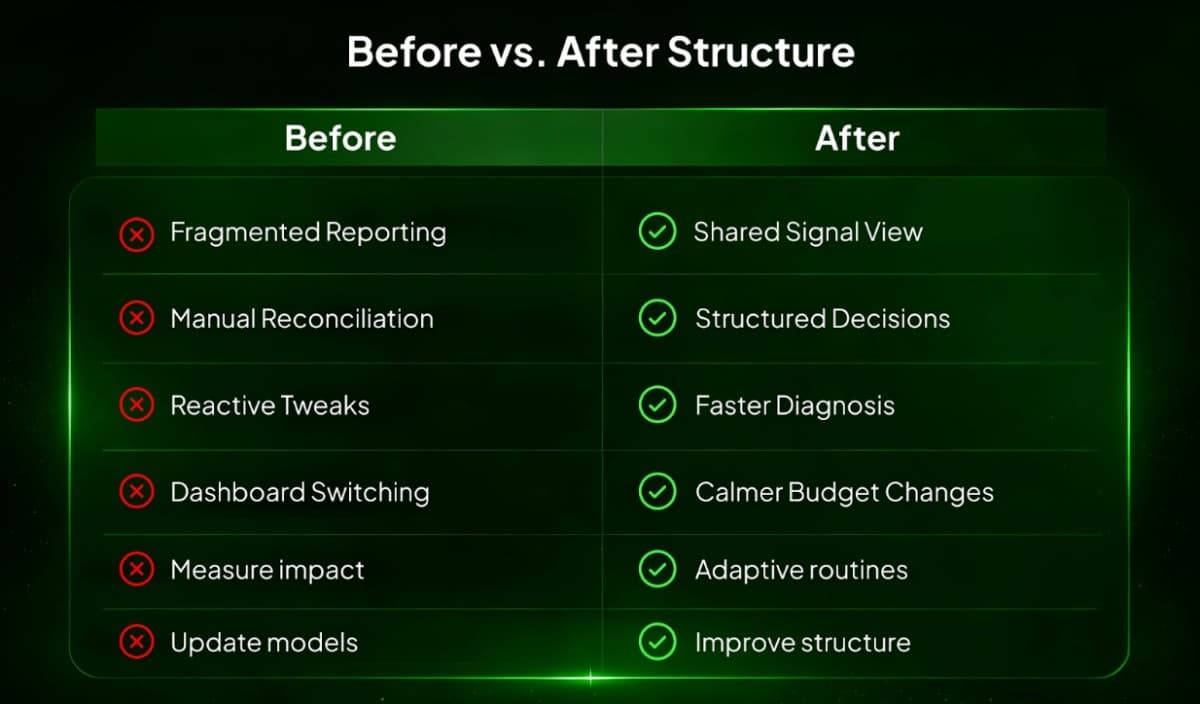
Teams spend less time reconciling dashboards and more time steering outcomes, because diagnosis and decisions move faster on comparable signals.
In practice, it feels like fewer “reporting weeks” and fewer debates about which numbers are real. Experiments become easier to judge because the structure is consistent, and budget moves become calmer because the logic is shared across channels. You spend less time defending performance and more time improving it.
Visual suggestion: A before/after mini table (Manual reconciliation → Shared signal view, Reactive tweaks → Structured decisions).
What Breaks When Architecture Is Weak (And Why It’s Invisible)
Architecture usually fails quietly, then shows up as “volatility.” In AI-driven workflows, the downside is real: McKinsey’s 2025 survey reports that 51% of respondents from organizations using AI say their organizations have seen at least one instance of a negative consequence, with nearly one-third reporting consequences stemming from AI inaccuracy. A January 2026 ITPro report citing Gartner notes: “Organizations can no longer implicitly trust data or assume it was human-generated.”
How Marketing Leaders Should Build Better Architecture
Standardize measurement and event definitions, then enforce naming and taxonomy conventions so reporting is not manual cleanup. Define a KPI hierarchy with a clear north star and explicit trade-offs so automation cannot optimize one metric at the expense of another. BCG’s 2025 marketing measurement research emphasizes that leaders define “north star” KPIs that become shared currency across teams.
Climaty AI for Architecture-Level Campaign Performance
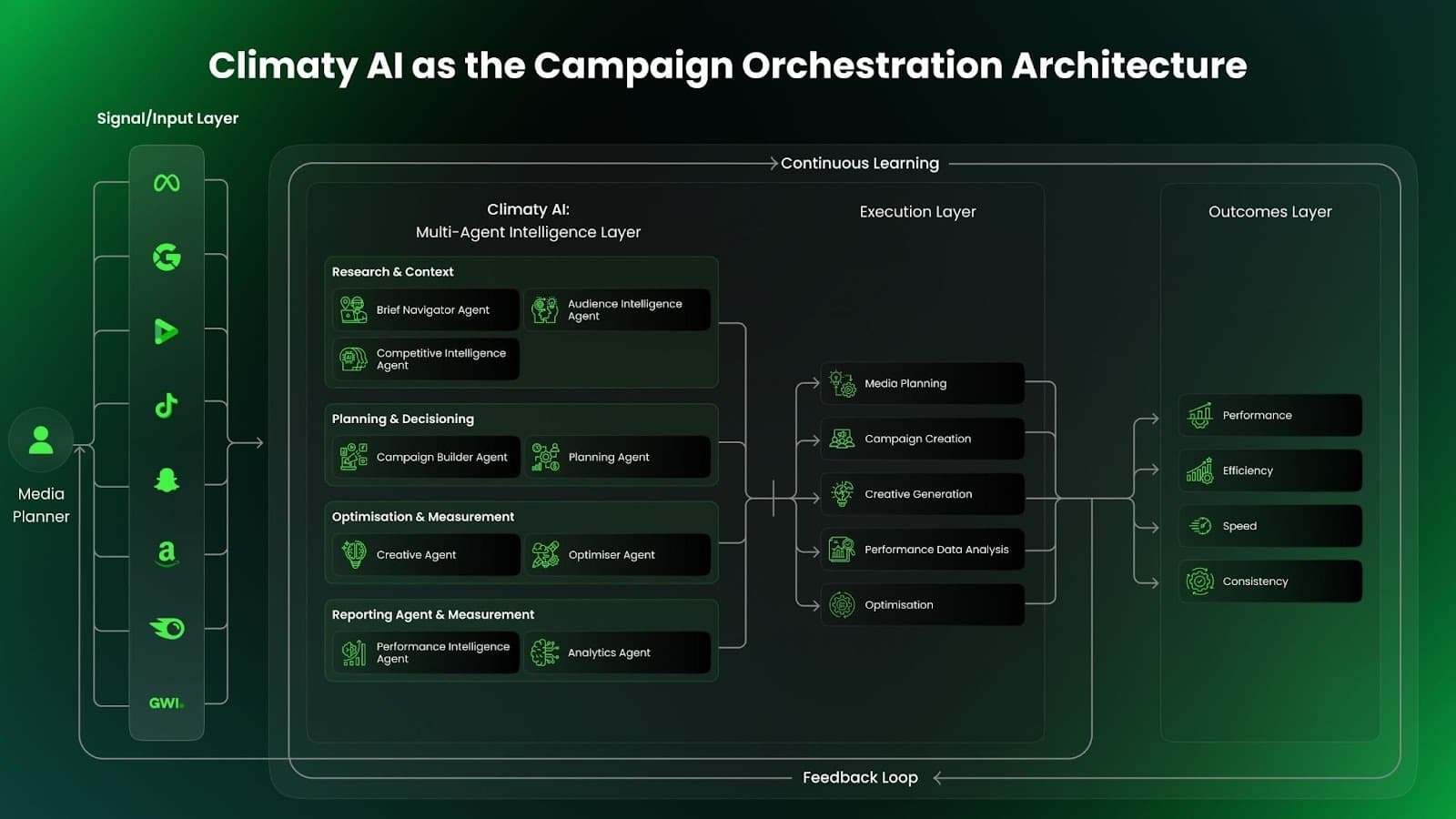
Climaty AI is designed for teams that want performance to be repeatable, not episodic. On its website, Climaty AI describes itself as “powered by a synchronized network of autonomous agents” and claims teams can “plan, create, iterate, and activate multi-channel campaigns within minutes.” In this context, the value is architectural: less manual reconciliation, faster diagnosis, and tighter loops from insight to execution.
Within that workflow, the ten-agent model maps directly to the pillars of campaign architecture, because each agent is responsible for keeping one part of the system coherent.
Intent and structure
Brief Navigator sets the objective hierarchy and constraints so “success” stays consistent.
Media Planning + Campaign Creation turn intent into repeatable buildouts so taxonomy stays clean and learnings roll up.
Shared context across channels
Audience Intelligence standardizes cohorts and segmentation logic.
Competitive Intelligence adds auction and market context so shifts aren’t misread in isolation.
Learning and iteration
Analytics + Performance Intelligence translate signals into driver-level explanations, faster and with less manual rebuilding.
Creative converts those learnings into iteration, keeping refresh proactive instead of reactive.
Explainability and control
Reporting turns performance into stakeholder-ready narratives so teams spend less time defending dashboards.
Governance enforces guardrails and escalation logic so optimization stays aligned with intent.
This matters because fragmentation is still the norm. IAB’s State of Data 2025 report states that 70% of agencies, brands, and publishers are not fully integrating AI across media planning, activation, and analysis, and notes that nearly two-thirds cite significant challenges, including data quality, data protection, and fragmentation among disparate AI tools.
Takeaway
High-performing campaigns are rarely a single brilliant move. They are a system that can repeat what works, and when the architecture is strong, performance becomes more stable, scalable, and compounding.
The teams that win consistently do not optimize harder, they architect better. Build the structure first, and every creative, budget move, and automation loop starts working for you instead of against you.



