
The Attention Economy Is Becoming a Scarcity Economy
Published on
1) The Scarcity Economy of Attention
Attention is no longer a nice-to-have outcome of delivery. It’s the constraint the entire system runs into. Ads can run perfectly and still do nothing if nobody pauses long enough to process what they’re seeing, and that is the difference between an ad that ran and an ad that landed.
Most marketing teams already feel this shift. Campaigns that used to scale smoothly now hit a ceiling faster, performance drops show up earlier than expected, and creatives wear out even when the message is strong. Spend that once produced clean incremental lift now produces more noise than signal, not because ads stopped working, but because the environment stopped rewarding exposure by default
2) The Current Reality: Why “More Reach” Is Producing Less Impact
Most teams are doing everything right on paper. More creative, more targeting refinement, more testing, more automation, more reporting. Yet outcomes flatten because attention is finite and competition is constant.
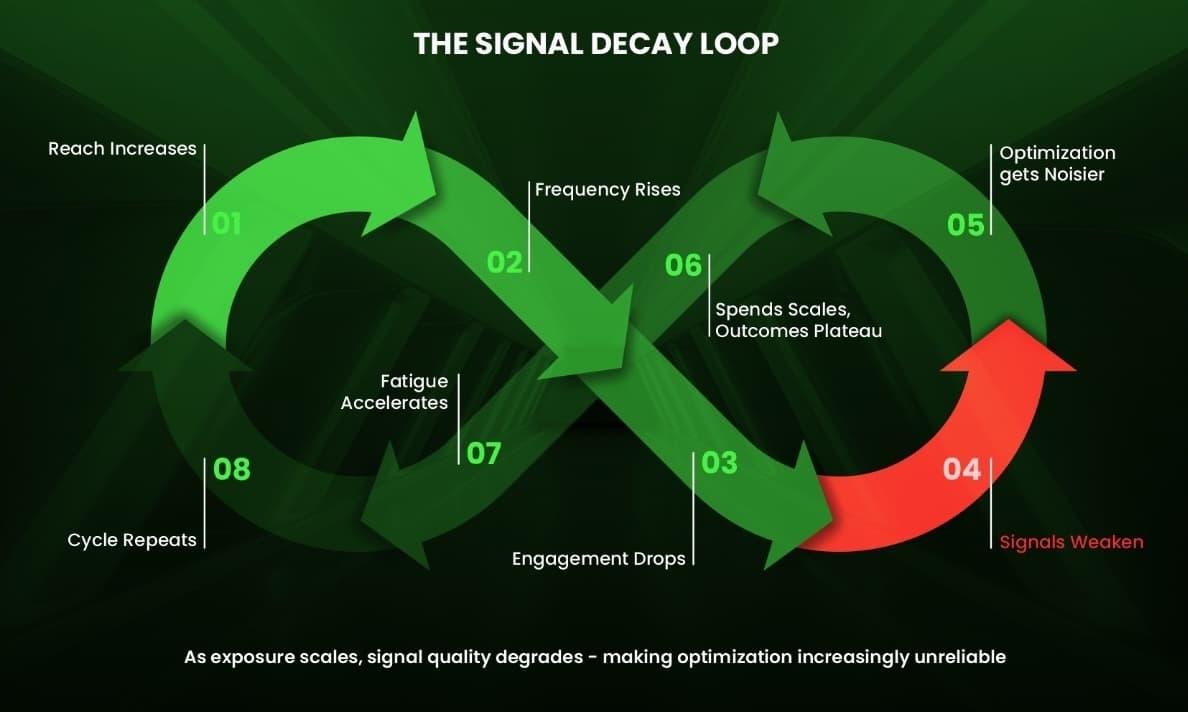
The modern loop often looks like this:
Reach increases → Frequency rises → Engagement drops → Fatigue accelerates → Signals weaken → Optimization gets noisier → Spend scales while outcomes plateau → back to Reach increases
This creates a specific kind of confusion. Performance teams look at delivery metrics and think the campaign is healthy. Creative teams look at engagement and think the message is failing. Leadership sees cost rising and wants quick fixes. But what is really happening is that the system is producing exposure without attention.
You can also see it in how quickly performance decays now. Campaigns do not always decline slowly. They fall off a cliff once saturation hits, because attention drops non-linearly. That is why the shift is not only about better creatives. It is about building systems that protect attention and prevent waste before it compounds.
Visual suggestion: a circular loop diagram of the sequence above, with “signal decay” highlighted.
3) What Attention Quality Means
Attention quality is not exposure. Exposure means the ad appeared. Attention means the ad was processed.
In practical terms, attention quality shows up as dwell or time spent, focus, memory, and action. This matters because performance depends on impact, and impact requires attention.
Attention quality also explains a familiar experience: two campaigns can have similar CPMs and similar reach, but one drives outcomes and the other does not. The difference is often not targeting accuracy. The difference is whether the creative earns attention long enough to communicate meaning.
When attention becomes the constraint, efficiency needs a new definition. Cheap delivery is not efficient if it produces no attention. True efficiency is meaningful attention per impression.
4) Why It’s Getting Worse
Attention scarcity is rising because multiple forces stack on top of each other.
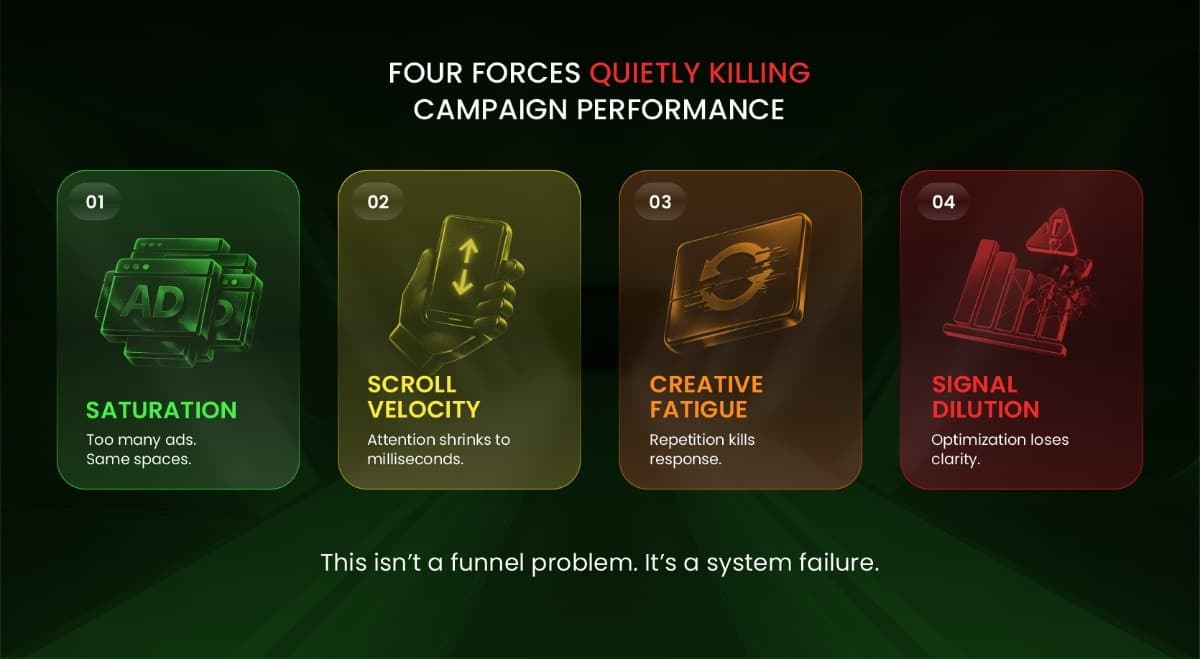
Saturation is the obvious one. As more brands compete in the same auctions, frequency rises and novelty declines, especially when audiences are narrow. Incremental lift drops while waste rises because the same people stop noticing repeated messages.
Scroll velocity compresses the time creative has to land. In feed environments, time-to-understand becomes a performance variable. Creative that takes too long to signal relevance gets skipped before the message arrives.
Creative fatigue accelerates under repetition. Even strong assets decay, but most teams treat refresh as a reaction rather than a designed system. In saturated environments, refresh has to be built into the workflow, because waiting for decline means the decline has already cost you.
Signal dilution is the hidden one. Optimization systems learn from engagement signals, and weaker attention creates noisier signals. When signals degrade, decisions become less reliable and optimization drifts toward what looks efficient but produces little real impact. The key idea is that attention scarcity does not only reduce engagement. It reduces learning. And when learning slows, compounding stops.
5) Attention Elasticity: Why Some Ads Hold and Others Collapse
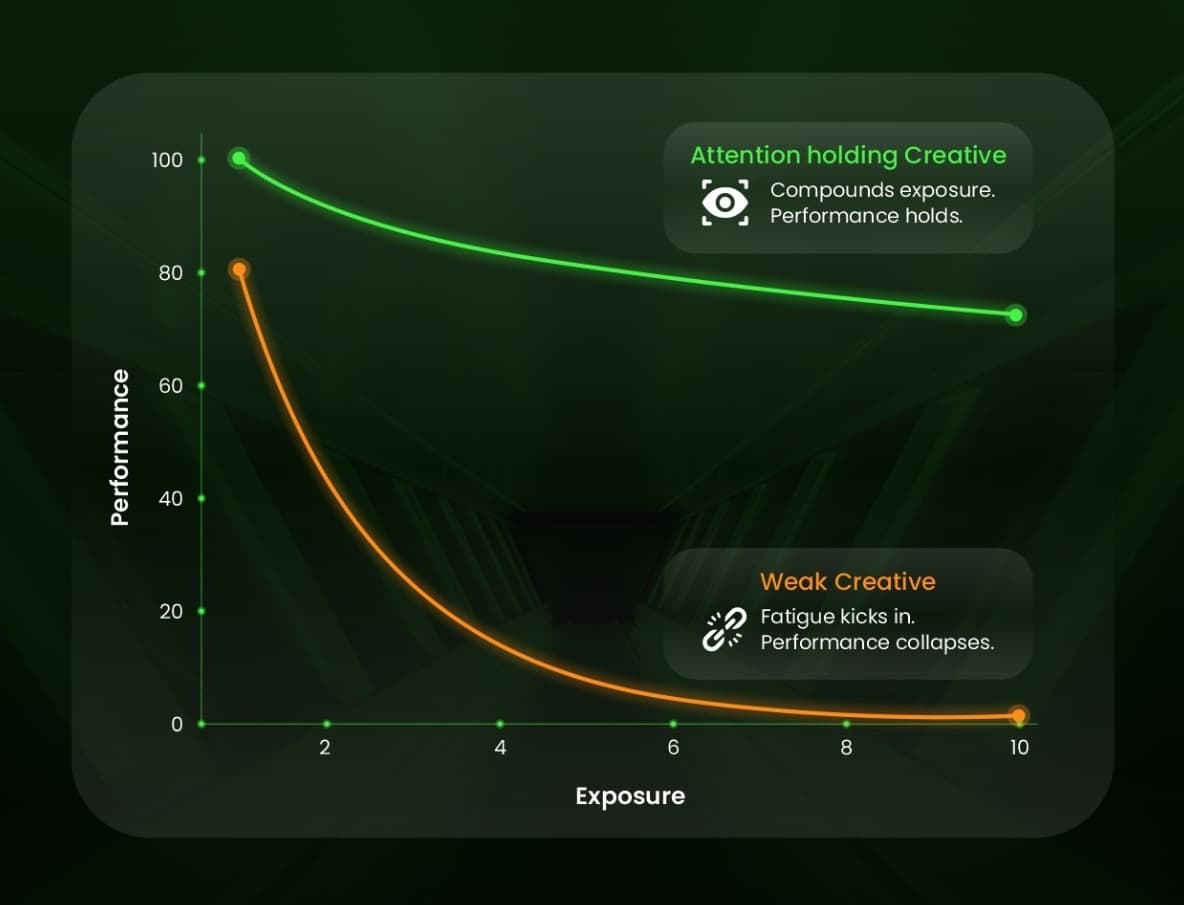
Attention is not fixed. It stretches and contracts based on creative quality and context. Under saturation pressure, weak creative collapses quickly while strong creative sustains attention longer. The same spend can produce very different outcomes depending on what holds focus.
That difference is attention elasticity. It explains why some ads keep working even at higher frequency, while others fail after a few exposures.
Elastic creatives tend to be clear and immediate. It signals relevance fast. It feels native to the environment without being invisible. It creates a memory trace instead of just a presence.
Inelastic creative needs perfect conditions to work. It collapses once competition rises because it does not earn the pause.
In a scarcity economy, creatives are not just content. Creative is a mechanism for earning attention, and the quality of that mechanism determines how long performance can hold.
Visual suggestion: a split graphic showing Elastic vs Inelastic creative under rising frequency.
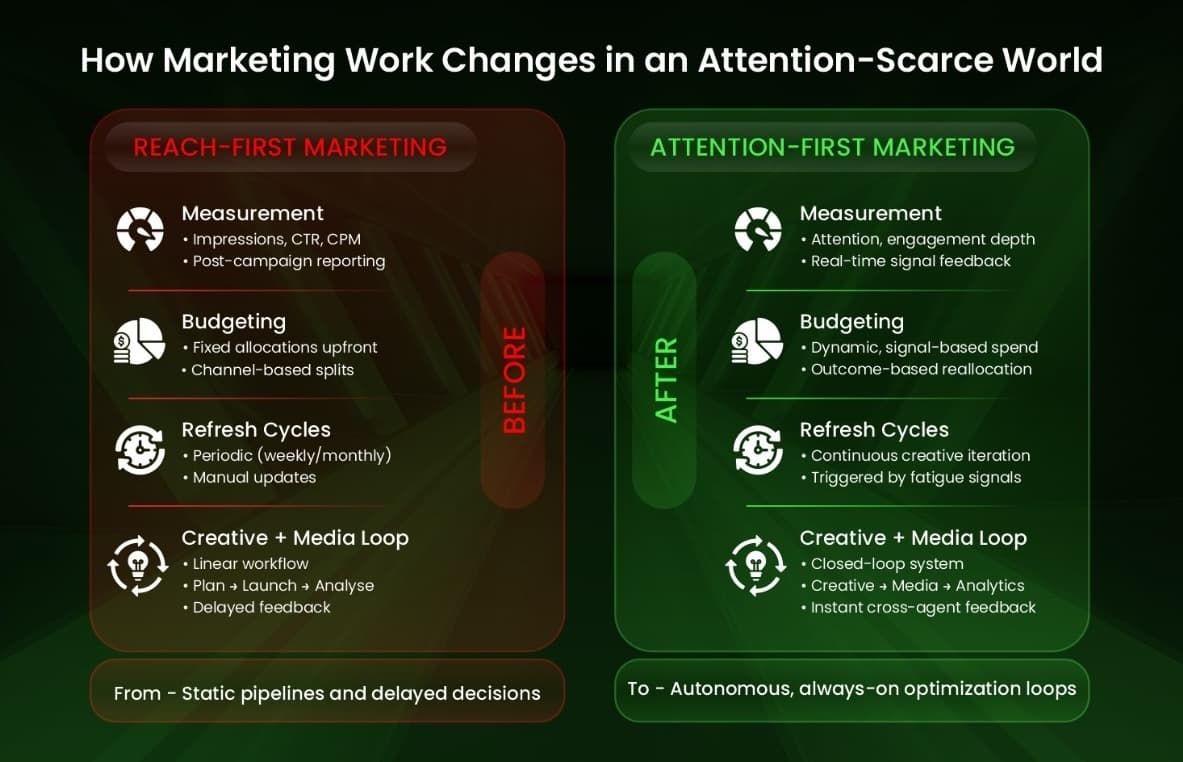
6) How Marketing Work Changes in an Attention-Scarce World
When teams shift from reach-first to attention-first, the work changes in subtle but important ways.
Measurement changes first. Teams stop asking only what did we spend and what did we get, and start asking what did the audience actually notice. That shifts what gets scaled and what gets killed. It also makes it easier to diagnose whether a problem is message, placement, audience, or frequency.
Budgeting changes next. Spend starts flowing toward formats, placements, and creative patterns that hold attention, rather than simply delivering the most impressions at the lowest cost.
Refresh cycles become proactive. Teams plan to refresh before fatigue hits, because attention decay is expected under saturation. Creative and media start operating as one loop: creative performance informs delivery decisions, and delivery outcomes inform the next creative iteration.
Visual : Before vs After
7) What Breaks Teams First When Attention Is the Constrain
The common mistake is treating attention scarcity as only a creative problem. Teams produce more assets, but frequency remains unmanaged, audience pools stay narrow, and the system repeats the same message too aggressively. In those conditions, even good creatives collapses faster.
Another mistake is optimizing for cheap reach because it looks efficient on paper. Cheap reach can be the fastest route to dilution if it delivers impressions without attention. If measurement rewards delivery instead of impact, teams will keep buying volume while losing outcomes.
Lumen’s research on clutter and divided attention makes the underlying risk explicit: attention is finite, and clutter dilutes impact. In cluttered environments, ads can be viewable but not viewed, which is the definition of exposure without attention.
8) How to Prepare for the Attention Scarcity Era
Preparing for attention scarcity is not about chasing new formats. It is about designing for depth.
Start by choosing a small set of attention signals you trust and standardize them across reporting. Treat frequency as a constraint to manage, not a number to tolerate. Plan refresh cycles before fatigue hits, not after. Separate exploration creative from scaling creative so learning does not get stuck. Align creative and performance teams on what attention success looks like so iteration is evidence-led, not opinion-led.
Teams that treat attention as a core constraint will outperform teams that treat it as an afterthought.
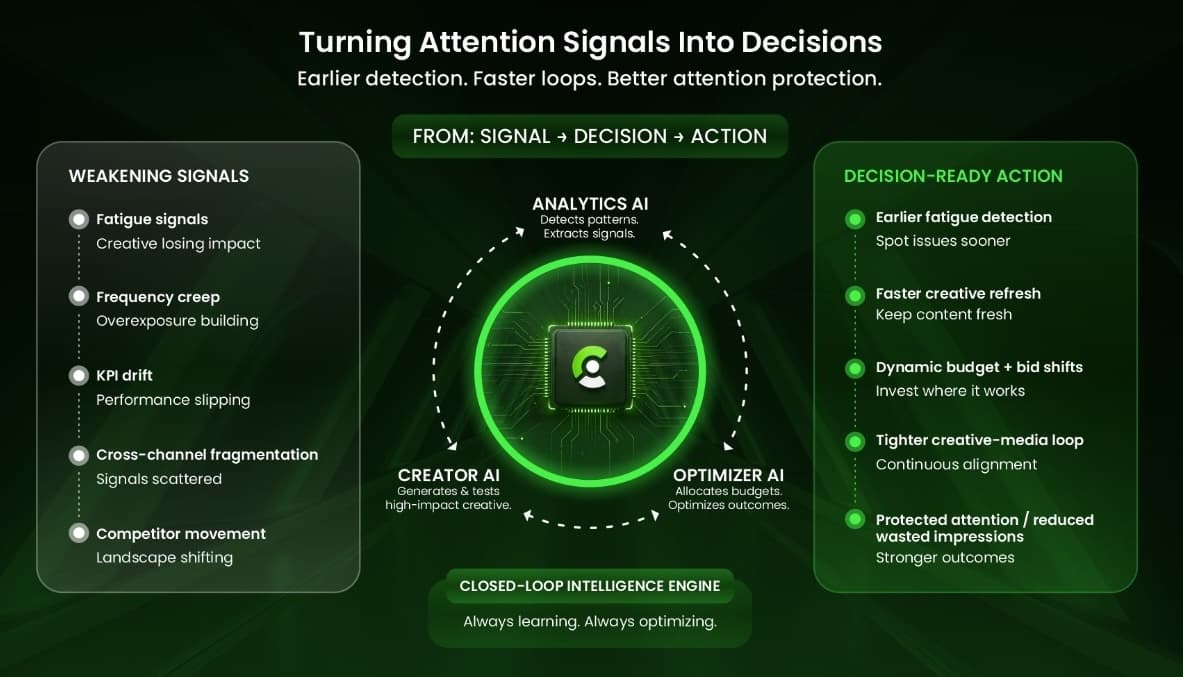
9) Climaty AI: Turning Attention Signals Into Decisions
Climaty AI is built for teams operating in this reality. We are powered by a synchronized network of autonomous agents, designed to help teams move faster from signal to decision to action when attention conditions shift.
In attention-scarce environments, the practical value is earlier detection and faster loops. Instead of discovering fatigue after outcomes collapse, teams need early saturation signals and decision-ready diagnosis across channels.
Our Analytics AI focuses on instant cross-platform insights, KPI analysis, and competitor benchmarking, which is the kind of unified view teams need when signal quality is weakening. Our Creator AI is designed to score, generate, and adapt creatives to match campaign goals, supporting elasticity by making refresh more systematic. Our Optimizer AI is designed to control bid, budget, and targeting dynamically to deliver performance, which matters when frequency and saturation need to be managed continuously rather than in weekly cycles.
The goal is not more output. The goal is depth-led optimization: protect attention, reduce wasted impressions, and keep the creative and media loop tight enough that learning compounds.
10) Takeaway
Attention is the currency now. Design for depth, not just reach. Protect attention or keep paying more for less.
The most important shift is not buying different inventory. It is measuring different value. When teams treat attention as a primary constraint, they stop scaling exposure for its own sake and start scaling what actually lands.
Brands that build for attention will compound performance. Brands that optimize only for delivery will keep paying more for less.



