
New Age Marketing: How Machine Learning is Changing the Traditional Pipeline
Published on
Summary
Pushing out campaigns through traditional marketing funnels means long lead times, large teams, and big budgets for ideal results. Marketers are expected to deliver more with less, while keeping up with rapidly shifting consumer expectations.
But with MarTech like AI and Machine Learning, the landscape is already undergoing structural changes. With Agentic AI in marketing, a faster and simpler era of marketing is already underway.
Introduction
Marketing has evolved far beyond gut instinct and campaign sprints. AI isn’t novel anymore.
Dynamic creative optimization, predictive analytics, and automated bidding are already part of a marketer’s toolkit. But most systems today aren’t autonomous. They’re assisting decision making, not spearheading it.
Agentic AI shifts that paradigm.
And it’s the foundation of how Climaty AI is designing the next era of media execution.
Agentic AI in Marketing
Traditional MarTech systems work like digital assistants. They enhance campaign execution, but require clear instructions, frequent input, and heavy manual management.
AI in this context is task-specific: a bidding engine in one place, a creative recommendation tool in another, and an analytics dashboard somewhere else. It’s scattered and leaves too much room for gaps and inefficiencies.
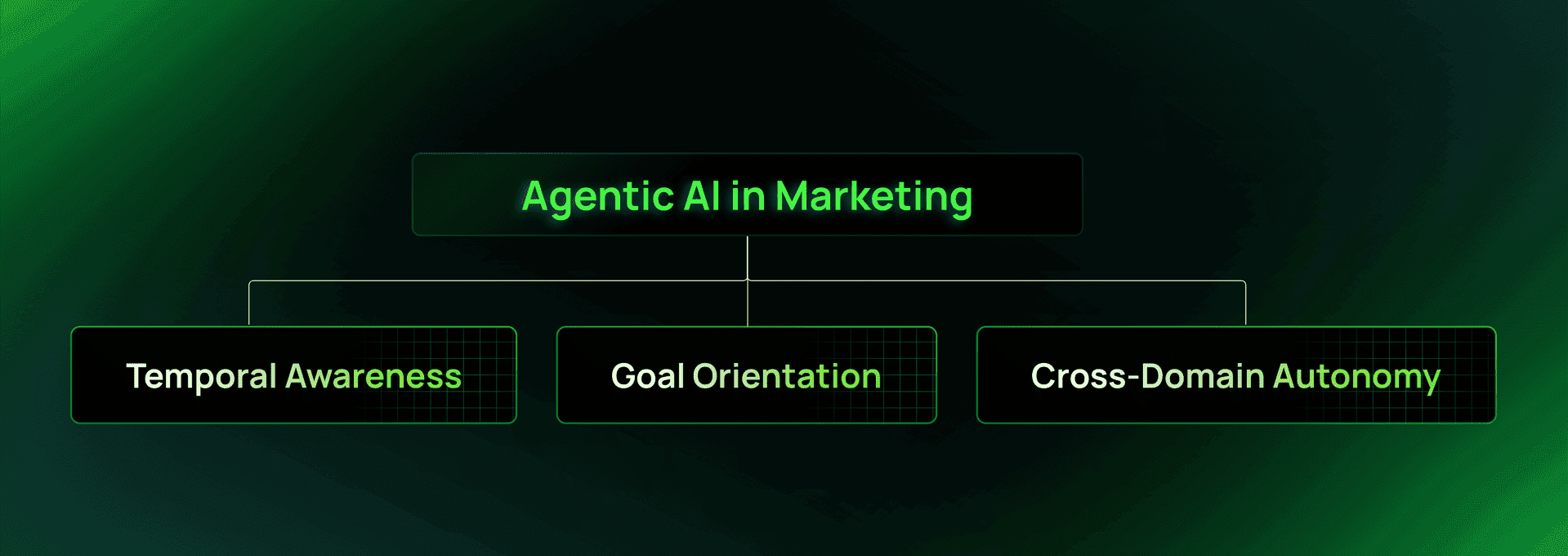
Agentic systems, in contrast, are designed for continuity. They move from discrete tasks to persistent objectives. Think of them as semi-autonomous marketing operators trained on your goals, media rules, and contextual data. Their advantage lies in:
- 1. Temporal awareness: They learn over time, adjusting with every interaction.
- 2. Goal orientation: They interpret campaign outcomes and reorient actions toward KPIs.
- 3. Cross-domain autonomy: They navigate creative, media, and analytics workflows simultaneously without manual handoffs.
How Climaty AI’s Agentic Stack Operates
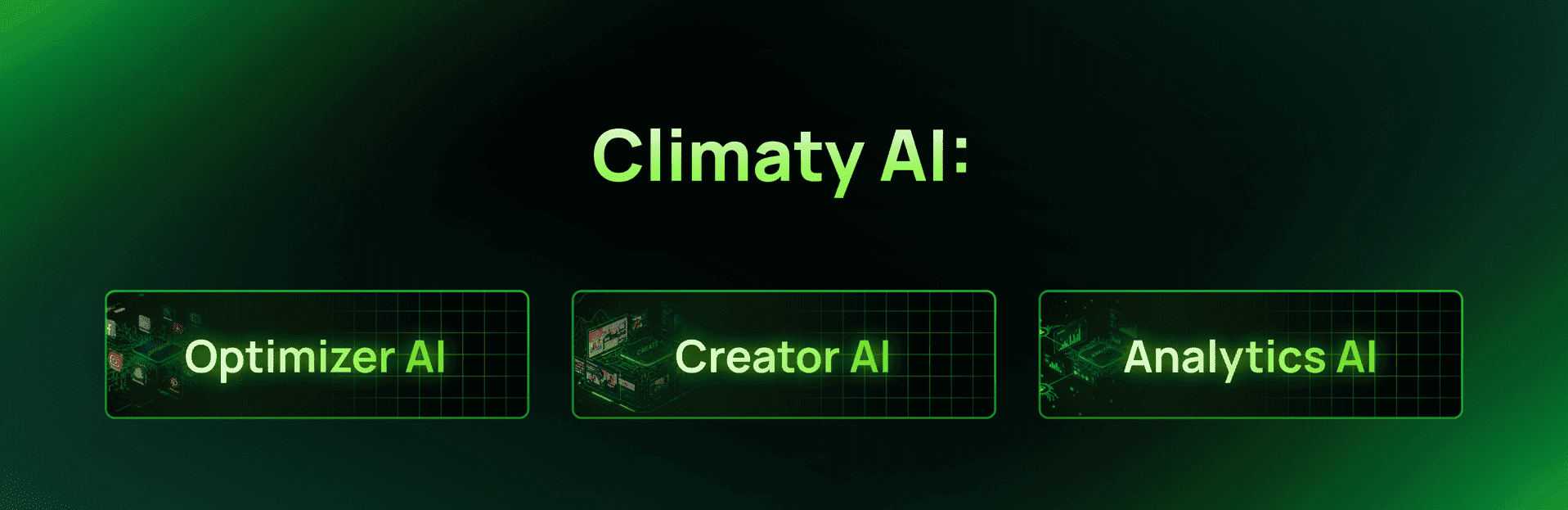
At the core of Climaty AI is a network of task-specific agents, each designed to function like a domain expert for marketers. These agents learn from campaign signals, adjust autonomously, and work toward defined business goals within a secure, brand-governed environment.
Let’s take a closer look:
-
1. Optimizer AI
Optimizer AI processes real-time campaign signals such as bid landscapes, pacing shifts, CTR patterns, and cost dynamics to autonomously adjust campaigns mid-flight. It aligns its logic with your campaign goals, whether that’s ROAS, reach, or efficiency, and syncs performance insights from platforms like Google or Meta to inform cross-platform Bid/budget and creative reallocation.
-
2. Creator AI
Creator AI supports the full lifecycle of creative development. It evaluates existing assets, generates static and video variants based on brand guidelines, and even creates new formats from scratch using your inputs. The agent adapts based on creative performance and your feedback, and auto-resizes outputs for different channels while enabling stakeholder approvals before deployment.
-
3. Analytics AI
Analytics AI transforms scattered reporting into structured insights. It centralizes performance data by funnel stage, keyword, and spend through SSO integrations or CSV uploads. You can filter for deep analysis, rely on the platform’s AI assistant for summaries and recommendations, and get alerted instantly when KPIs deviate from expected benchmarks.
Why Agentic AI Outperforms Conventional ML
Most AI applications in marketing today still operate within predefined loops: plan, execute, measure, and adjust. Even with machine learning, these systems tend to apply insights post-hoc, analyzing past performance to inform future decisions.
This often leads to delayed optimization, where actions lag behind changing consumer behavior, media dynamics, or competitive activity.
But Agentic AI introduces a continuous mode of decision-making. It shifts from episodic intervention to persistent analysis and action, embedded across the marketing cycle.
-
1. Scenario-Sensitive Planning
Instead of relying solely on static forecasts or historical patterns, planning systems can now incorporate real-time variables such as current inventory levels, regional demand spikes, media volatility, or competitor pricing to simulate multiple pathways and assess likely outcomes.
-
2. Adaptive Execution for Proven Performance
Rather than following pre-programmed rules, execution systems evaluate performance in context and respond accordingly. Underperforming assets can be de-emphasized or paused; budget distribution can shift across platforms based on updated ROI signals, with minimal manual intervention.
-
3. Diagnostic Measurement for Enhanced Optimization
Performance data is both collected and interpreted. When campaigns fall short of expectations, systems can trace back through decision chains and identify contributing factors, from targeting mismatches to external market shifts, enabling more targeted mid-flight adjustments.

Why Agentic AI Matters
Most marketing stacks today are still reactionary. They require marketers to interpret data, make adjustments, and manually sync insights across siloed platforms. That lag creates inefficiency and missed opportunities.
Agentic AI addresses this by compressing the decision cycle. These systems are built for continuity: they plan dynamically, execute autonomously, and optimize continuously. Rather than reacting to lagging indicators, agentic systems act on real-time inputs, ensuring marketing remains responsive to the market in motion, not the market in hindsight.
They also bring a more responsible infrastructure. Agentic AI can operate within privacy-first environments, adhering to brand-specific guardrails.
Conclusion
Traditional MarTech stacks, even with AI, often require excessive manual coordination and delayed responsiveness.
Agentic AI is reshaping marketing by replacing brittle, tool-based workflows with intelligent systems that learn, adapt, and operate with purpose.
As brands navigate growing complexity, agentic systems will become the operating layer that holds it all together. Not just faster. Not just smarter. But fundamentally better aligned with the way modern marketing should work.



