
Can AI Be Your Performance Partner? A Look at Multi-Agent Collaboration
Published on
Summary
As marketing leaders, we know the story too well: operational overload eats into our calendars. Fragmented channels, compliance reviews, attribution disputes. Consequently, all of it steals time away from the one thing that should matter most: strategy.
This is where Agentic AI steps in as your performance partner.
Instead of one model trying to be a jack-of-all-trades, Climaty AI brings a multi-agent ecosystem that plans, analyzes, creates, and executes, always within brand guardrails and approvals.
We steer direction and outcomes. The agents handle the execution.
This blog outlines how multi-agent AI works in practice, why it matters, and what we need in place to scale it responsibly.
The Operational Problem Faced by Fellow Marketers
If we step back, most of us aren't short on tools, instead we're drowning in them. Each channel carries its own dashboards, reporting quirks, and compliance checks. The result?
- 1. Context Fragmentation
We jump between CRM, ad managers, analytics, and creative tools, never seeing the whole picture.
- 2. Compliance Drag
Tone, claims, spend caps, and privacy rules each demand manual checks and sign-offs.
- 3. Attribution Conflicts
Different platforms tell different stories, leaving us reconciling KPIs instead of acting on them.
The real cost isn't just license fees. It's the hours lost; hours that should have gone into strategy, but instead vanish into execution overhead.
How do AI Agents Operate in Marketing
If AI can think alongside your media team, how does it actually show up in the day-to-day? Think of it as an operating layer across your media stack that understands context, proposes or executes actions through approvals. Here's what it covers in your workflow:
- 1. Live Media Context
Connects to channels through SSO, consolidating budgets, objectives, and audiences in one view
Maps campaigns to funnel goals and outcomes with permissioned access
- 2. Acts With Guardrails
Operates within spend caps, exclusion lists, brand tone, privacy rules, and defined approval flows
Runs pre-flight checks for compliance and keeps full audit trails
- 3. Closes The Loop
Flags KPI drift in real time and recommends fixes
Reallocates budgets toward business outcomes like ROAS, CPL, CPM, and LTV
This cycle runs continuously, execution gets taken care of, and you steer the growth strategy and performance.
Single-Agent Systems in Silos vs Interconnected Multi-Agent Infrastructure
When evaluating AI in marketing, the difference isn't just in how many agents are deployed; it's in how they interact.
Most existing setups rely on multiple single agents that work independently. Each one is built to handle a narrow function, generating creatives, analyzing performance, or managing bids, but they operate in silos.
- • Context fragmentation, where insights and actions remain disconnected.
- • Duplicated data and effort, as each agent learns from its own inputs.
- • Governance gaps, with no central alignment on tone, spend, or objectives.
- • Scaling inefficiency, since adding more tools often increases friction instead of reducing it.
An interconnected multi-agent system, by contrast, enables specialized agents to collaborate within a shared framework. Each agent retains its domain expertise but exchanges data, feedback, and context with others, ensuring that insights, creativity, and optimization operate as one continuous loop.
What To Consider Before Deploying Multi-Agent Teams
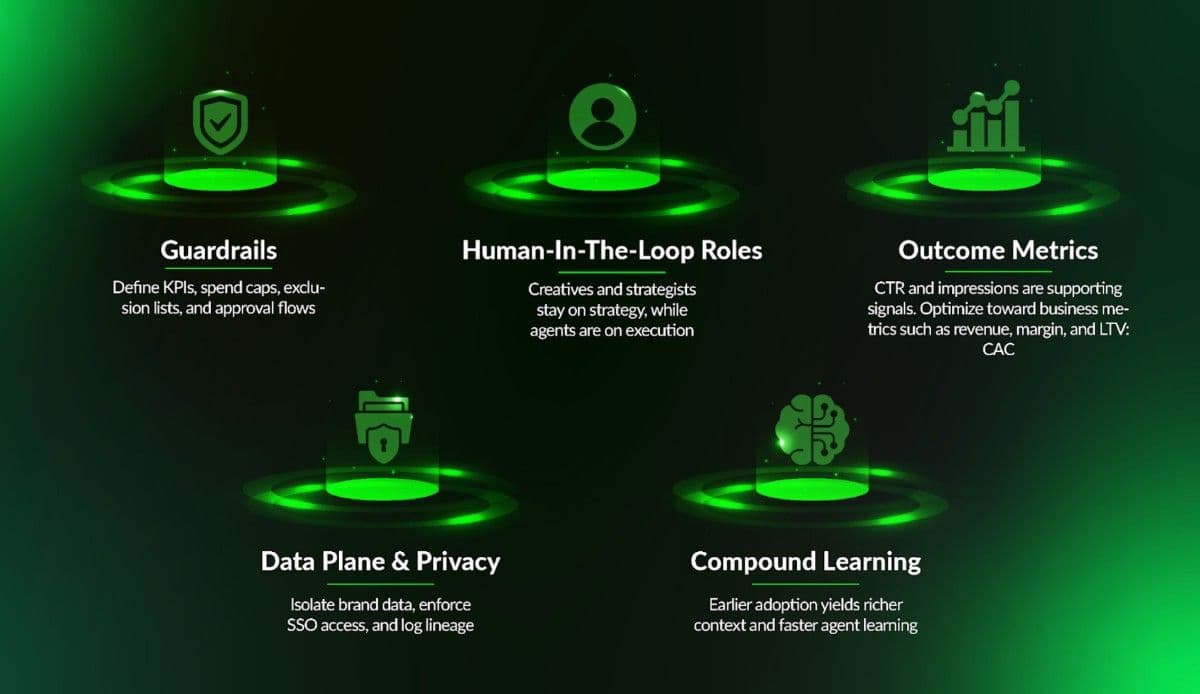
Rolling out multi-agent AI is an operating decision as much as a technology choice. Set these foundations to scale with confidence:
- 1.Guardrails
Define KPIs, spend caps, exclusion lists, and approval flows
- 2.Human-In-The-Loop Roles
Creatives and strategists stay on strategy, while agents are on execution
- 3.Outcome Metrics
CTR and impressions are supporting signals. Optimize toward business metrics such as revenue, margin, and LTV: CAC
- 4.Data Plane & Privacy
Isolate brand data, enforce SSO access, and log lineage
- 5.Compound Learning
Earlier adoption yields richer context and faster agent learning
Inside Climaty AI's Multi-Agent Infrastructure
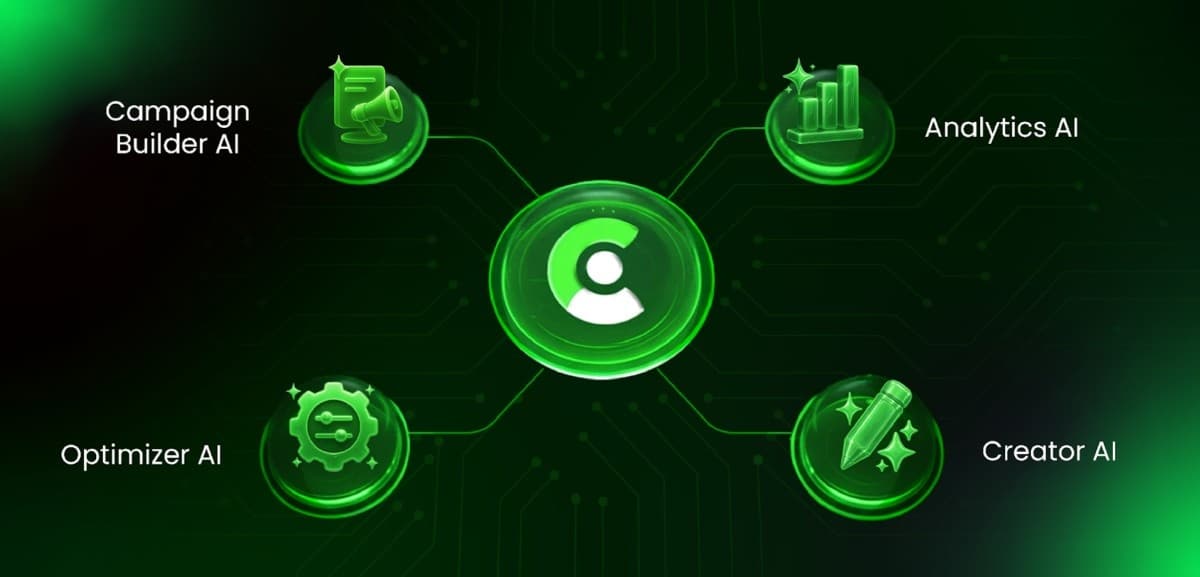
At Climaty AI, we've built our system to act like a CMO working inside your stack. Our Agentic AI model coordinates safely across channels, respects guardrails, and compounds learning over time, with agents like:
-
1.Campaign Builder AI
A collaborative system that converts high-level marketing goals into executable campaign strategies.
• Generates full-funnel campaigns from a single strategic prompt
• Platform-specific ad set creation and autonomous ICP identification
• Validates proposals against brand tone, budgets, and compliance constraints
• Supports one-click activation
-
2.Analytics AI
A cross-platform analytics dashboard; also acts as a multi-source query engine with a cognitive agent-based chat interface.
• Integrated data access with SSO connections for Meta, Google, and DV360
• Granular analytics that offer views by funnel stage, keyword, and creative spend
• Real-time alerts that flag KPI deviations instantly and offer corrective actions
• Built-in analytical interface that provides context-aware optimization guidance aligned to your objectives
-
3.Creator AI
Generates static and video assets with creative scoring and predictive analytics.
• Assigns creative performance scores and provides actionable improvement recommendations
• Generates static and video creatives from scratch based on the brand tone
• Optimizes format outputs and aspect ratios for cross-channel adaptation
• Generates optimized variants of high-spend creatives to improve ROI
-
4.Optimizer AI
A decision support and advisory layer for campaigns that works on unified signals from multiple ad platforms.
• Evaluated and reallocates budget and bids to meet ROAS or reach targets
• Monitors real-time delivery to ensure spend aligns with daily and lifetime pacing rules
• Surfaces audience-level insights and keyword enhancements via targeting intelligence
• Predicts potential project outcomes under alternate pacing and bidding scenarios
Conclusion: From Operator to Strategist
Agentic AI isn't here to take our place but to change the balance of our work.
We define the objectives and guardrails. The agents manage the execution, surface insights, and adapt with every cycle.



