
AI Agents in Marketing: What Modern Marketers Need to Know
Published on
Summary
AI agents are completely upturning the ways in which marketing teams have traditionally operated until now. With brand and consumer interest increasingly shifting toward AI capabilities and reducing production costs, agentic AI has been gaining steady popularity as the go-to for campaign planning and execution.
This blog explores how agentic AI is transforming campaigns and what marketers must do to stay ahead.
The Rise of Agentic AI in Marketing
Artificial Intelligence was once an experimental endeavor, but it has now become a functional driver of business innovation across industries. What began as simple automation has grown into autonomous systems that are fervently supporting mainstream industries like finance, logistics, customer support, and healthcare. Marketing is no exception, and the shift is already underway.
In this neo-marketing landscape, the AI marketing agent is not just executing tasks. It is analyzing live signals, making data-informed decisions, and coordinating execution across platforms. Unlike traditional marketing stacks, it does not rely on fixed workflows or require constant supervision.
For marketers like you, this shift is a signal that it is time to adapt to a model where AI agents are inevitable collaborators in achieving your goals.
What Role Does an AI Agent Play in Marketing?
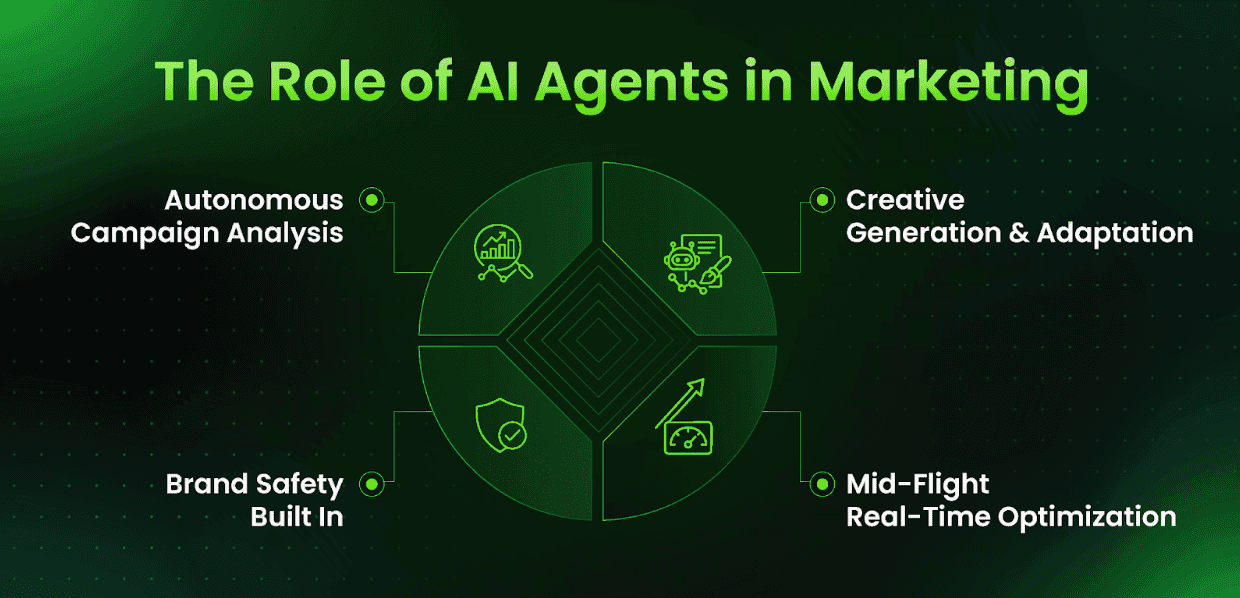
An AI marketing agent is a self-directed entity capable of independently managing marketing tasks like creative generation, media buying, or analytics. Each AI agent for marketing operates based on predefined campaign objectives, live feedback, and data signals.
What makes marketing AI agents different from standard automation is their autonomy. These agents can track campaign health, adjust pacing, test new creatives, and make real-time optimizations. They learn from outcomes and improve continuously without needing constant manual reconfiguration.
This decision making ability is the core of agentic AI.
Why Marketing is Adopting Agentic AI
The marketing industry has reached the limits of traditional automation. Campaign managers, bid rules, and basic dashboards can only go so far when strategies need to adapt by the hour across channels and audiences to remain competitive.
These capabilities make agentic systems highly aligned with the speed and complexity of AI in marketing today.
Agentic AI versus Static Automation
Agentic AI goes beyond the capabilities of basic automation, which is one of the primary reasons why marketers and brands trust agents to handle their marketing campaigns.
How AI Agents Are Changing Marketing
Agentic AI is already transforming key marketing workflows, especially in areas where speed, feedback, and personalization matter most.
1. Content Marketing
An AI agent for marketing can generate content across formats like banners, video scripts, and visuals. You no longer need to manually brief design teams for every asset version.
2. Media Buying
Instead of rigid bid strategies, AI marketing tools use real-time bid signals, pacing, budget allocation, and audience behavior to optimize delivery. These media agents operate continuously, not on fixed schedules, helping you adapt faster to campaign trends.
3. Analytics and Reporting
No more waiting for static reports. Analytics agents surface real-time insights, detect anomalies, and suggest actionable next steps. They connect data across media, creative, and conversion layers, giving you a unified view.
How You Can Adapt as a Modern Marketer
Agents are replacing the old marketing pipeline, but not the marketers themselves. The way forward for marketers is to work with agents collaboratively.
Here's how to shift your role in an AI marketing ecosystem:
1. Redefine Your Role
Rather than prioritizing execution, shift your focus to strategy. Prioritize setting the right goals, configuring brand guardrails, and shaping how AI agents behave for your projects. Your influence comes from defining context, not micromanaging execution.
2. Set Clear Objectives and Boundaries
The better your agents understand campaign KPIs, brand tone, and escalation points, the more confidently they can act on your behalf. Autonomy works best when direction is clear.
3. Design for Feedback Loops
Think of your system as a living cycle, not a static flow. Use structured tagging, granular performance insights, and iterative testing to fuel agent learning over time.
4. Choose Tools Designed for Agentic Workflows
Look for platforms built that are for autonomy, offering visibility, override paths, and agentic collaboration at scale. Climaty AI was created with this in mind by marketers, for marketers.
Climaty AI: Building for an Agentic Future
Climaty AI is built for the new era of agentic marketing. Our 3 autonomous agents are designed for modern media challenges, keeping brand safety and campaign efficacy in mind.
-
1. Creator AI
Creator AI supports the complete lifecycle of creative development. It evaluates existing assets, generates static and video variants aligned with brand guidelines, and can produce new formats based on marketer inputs.
The agent adapts based on performance signals and feedback, auto-resizes creatives by channel, supporting review and approval workflows before deployment.
-
2. Optimizer AI
Optimizer AI autonomously manages live media delivery. It processes real-time campaign signals like bid environments, pacing trends, CTR fluctuations, and cost dynamics to adjust campaign execution mid-flight.
Optimizer AI aligns with your chosen goals, such as ROAS, reach, or delivery efficiency, and syncs with platforms like Google, Meta and DV360 to inform budget shifts, targeting refinement, and creative allocation across formats.
-
3. Analytics AI
Analytics AI transforms fragmented reports into structured campaign intelligence. It centralizes performance data across funnel stages, keywords, formats, and spend through SSO integrations or CSV imports.
Marketers can explore granular performance filters, generate AI-powered summaries, and receive alerts when KPIs deviate from benchmarks. Climaty AI's built-in assistant also enables quick queries and guided decision-making.
Give Your Brand a Competitive Edge with Agentic AI Built for Outcomes.
Conclusion
AI agents are here and already retiring most traditional marketing methodologies. The rise of agentic AI in marketing marks a significant shift toward systems that are intelligent, adaptive, and outcome-focused.
The marketers who succeed in this shift will not be those who resist it, but those who design systems and workflows that complement these new capabilities.
Climaty AI is building the agentic layer for the future of marketing. With autonomous tools you can configure, monitor, and trust, we're helping brands work smarter while moving faster. The new competitive edge in today's marketing landscape is not outfoxing AI, but adapting to it.



